
Algebra Relations and Functions
Authored by Anthony Clark
Mathematics
9th Grade
CCSS covered


AI Actions
Add similar questions
Adjust reading levels
Convert to real-world scenario
Translate activity
More...
Content View
Student View
15 questions
Show all answers
1.
MULTIPLE CHOICE QUESTION
1 min • 1 pt
The school is selling raffle tickets as a fundraiser. The profit from the tickets can be modeled by the equation P(x) = 3x - 35, where x is the number of tickets sold. Which best describes the possible domain?
all real numbers greater than 0
all whole numbers
any rational number greater than 0
all integers
2.
MULTIPLE CHOICE QUESTION
1 min • 1 pt

State the constraints, if any, on the given function.
x ≠ 0
x ≠ 2
x ≠ -2
No restrictions
3.
MULTIPLE CHOICE QUESTION
1 min • 1 pt

State the constraints, if any, on the given function.
x ≠ 0
x ≠ 2
x ≠ -2
No restrictions
4.
MULTIPLE CHOICE QUESTION
1 min • 5 pts
Let 𝐹 be a set of ordered pairs such that {(−3,5),(3,0),(2,2)}. Which of the following statements about the relation is true?
The relation is a function because no value in the domain goes to multiple values in the range.
The relation is a function because all values in the range are different.
The relation is not a function because one value in the domain goes to multiple values in the range.
The relation is not a function because there is an ordered pair where the domain is equal to the range.
Tags
CCSS.8.F.A.1
5.
MULTIPLE CHOICE QUESTION
1 min • 5 pts

Which choice also represents the relation shown in the sets below as correct ordered pairs?
{(1,2),(2,4)}
{(2,1),(4,2),(6,2)}
{(1,2),(2,4),(2,6)}
{(2,2),(2,4),(2,6)}
Tags
CCSS.8.F.A.1
CCSS.HSF.IF.A.1
6.
MULTIPLE CHOICE QUESTION
1 min • 5 pts

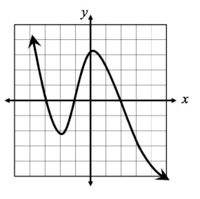
Is the relation above a function?
Yes, because it doesn’t show any repeating 𝑥 values in the domain.
Yes, because every 𝑦 value in the range is different.
No, because one 𝑥 value in the domain goes to multiple different 𝑦 values in the range.
No, because there is an 𝑥 value in the domain that is equal to a 𝑦 value in the range.
Tags
CCSS.8.F.A.1
7.
MULTIPLE CHOICE QUESTION
1 min • 5 pts

The first number in an ordered pair is...
the larger number.
the origin.
the x-coordinate.
the y-coordinate.
Tags
CCSS.5.G.A.1


Access all questions and much more by creating a free account
Create resources
Host any resource
Get auto-graded reports

Continue with Google

Continue with Email

Continue with Classlink

Continue with Clever
or continue with

Microsoft
%20(1).png)
Apple

Others
Already have an account?


