
Ecological Succession
Authored by Lisa Thompson
Science
7th Grade
NGSS covered


AI Actions
Add similar questions
Adjust reading levels
Convert to real-world scenario
Translate activity
More...
Content View
Student View
15 questions
Show all answers
1.
MULTIPLE CHOICE QUESTION
1 min • 1 pt

Stage IV will persist (stay the same) until it is altered (changed) by ______ ?
the growth in diameter of the trees
a major change in a biotic & abiotic factors
the reappearance of lichens and mosses
seasonal dieback of vegetation
Tags
NGSS.MS-LS2-4
NGSS.MS-LS2-1
2.
MULTIPLE CHOICE QUESTION
1 min • 1 pt

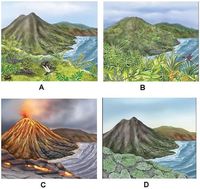
A glacier in Alaska has melted back a distance of 100 kilometers over the last 200 years. Four stages in this process are shown in diagrams A, B, C, and D below.
In which order should the diagrams be placed to represent the ecological succession that has taken place in the area?
C → D → A → B
D → C → B → A
C → D → B → A
D → C → A → B
Tags
NGSS.MS-LS2-4
NGSS.MS-LS2-1
NGSS.MS-ESS2-2
3.
MULTIPLE CHOICE QUESTION
1 min • 1 pt
Which statement about pioneer species is TRUE?
Pioneer species require soil to grow.
Pioneer species are organisms that are made up of only one cell.
Pioneer species thrive during the early stages of ecological succession.
Pioneer species, such as hardwood trees, thrive during the final stages of ecological succession.
4.
MULTIPLE CHOICE QUESTION
1 min • 1 pt
A vegetable garden goes unattended for a few weeks. Which organism will be the first to take over the area?
Weeds
Moss
Shrubs
Trees
Tags
NGSS.MS-LS2-4
5.
MULTIPLE CHOICE QUESTION
1 min • 1 pt
It occurs in areas where a community that previously existed has been destroyed by some type of natural disaster or human activity.
Primary succession
Secondary succession
6.
FILL IN THE BLANK QUESTION
1 min • 1 pt
An ecological community in which populations of organisms remain stable and exist in balance. It is the final stage of succession, remaining relatively unchanged until destroyed by an event such as a natural disaster or human interference.
Tags
NGSS.MS-LS2-4
7.
MULTIPLE CHOICE QUESTION
1 min • 1 pt
What is the main difference between primary and secondary ecological succession?
Primary begins WITHOUT soil; Secondary begins WITH soil
Primary is the first state and secondary is the second stage
Primary builds plant community; secondary builds animal community
Primary begins WITH soil; Secondary begins WITHOUT soil

Access all questions and much more by creating a free account
Create resources
Host any resource
Get auto-graded reports

Continue with Google

Continue with Email

Continue with Classlink

Continue with Clever
or continue with

Microsoft
%20(1).png)
Apple

Others
Already have an account?
Similar Resources on Wayground

12 questions
🦌LE 19-10 The Experiment of the Kaibab Plateau Deer

Quiz
•
7th Grade
16 questions
Harnessing Energy from Resources
Quiz
•
6th - 8th Grade
11 questions
QUIZ CHAPTER 2-LIFE SCIENCE 7°
Quiz
•
7th Grade
15 questions
Impression Evidence 1 (Dental/Impression Types)
Quiz
•
6th - 8th Grade
10 questions
Levels of Biological Organization
Quiz
•
7th Grade
19 questions
DNA & Traits - Genetics Biology Quiz
Quiz
•
7th - 10th Grade
12 questions
W1-2 Brainforest
Quiz
•
KG - 8th Grade
10 questions
Living Things
Quiz
•
7th Grade
Popular Resources on Wayground
15 questions
Fractions on a Number Line
Quiz
•
3rd Grade
20 questions
Equivalent Fractions
Quiz
•
3rd Grade
25 questions
Multiplication Facts
Quiz
•
5th Grade
29 questions
Alg. 1 Section 5.1 Coordinate Plane
Quiz
•
9th Grade
22 questions
fractions
Quiz
•
3rd Grade
11 questions
FOREST Effective communication

Lesson
•
KG
20 questions
Main Idea and Details
Quiz
•
5th Grade
20 questions
Context Clues
Quiz
•
6th Grade
Discover more resources for Science
10 questions
Exploring the Rock Cycle

Interactive video
•
6th - 8th Grade
20 questions
Flow of Energy
Quiz
•
7th Grade
12 questions
Ecological Succession
Quiz
•
7th Grade
20 questions
Waves and Wave Properties
Quiz
•
6th - 8th Grade
10 questions
Understand Ecosystem Roles and Energy Flow
Interactive video
•
6th - 8th Grade
10 questions
Exploring the Rock Cycle: Types and Formation
Interactive video
•
6th - 8th Grade
15 questions
Independent and Dependent Variables
Quiz
•
7th Grade
20 questions
Natural Selection and Selective Breeding
Quiz
•
7th Grade