
Earth Science Cast Review
Authored by Scott Ness
Science
11th Grade
NGSS covered
Used 8+ times


AI Actions
Add similar questions
Adjust reading levels
Convert to real-world scenario
Translate activity
More...
Content View
Student View
30 questions
Show all answers
1.
MULTIPLE CHOICE QUESTION
3 mins • 1 pt

How doe the pictures show heat transferring from the earth's surface into and throughout the air?
The air closer to the land always moves to the water and then rises into the sky, so cold air in the sky always falls to the land.
The air closer to the water always moves to the land and then rises into the sky, so cold air in the sky always falls to the water.
The air closer to the warmer surface moves up and away from that surface while the colder air falls and moves into the space that was left by the rising air
The air closer to the colder surface moves up and away from that surface while the hot air falls and moves into the space that was left by the rising air
Answer explanation
The correct choice explains that warmer air rises from the surface, creating a space that colder air fills. This process illustrates how heat transfers from the Earth's surface into the air, demonstrating convection.
Tags
NGSS.HS-ESS2-4
NGSS.HS-ESS2-3
2.
MULTIPLE CHOICE QUESTION
3 mins • 1 pt

What happens to the crust at the places where the movement of the mantle splits (going left and right at the same time?)
Friction between the Mantle and the Crust causes a force to pull the crust in the direction of the moving mantle, causing plates to move apart.
Friction between the Mantle and Crust cause a force to shake the plate causing earthquakes
Friction between the mantle and plate sucks the plate down under the mantle causing magma to erupt
The rising mantle pushes up making mountains.
Answer explanation
Friction between the mantle and the crust creates a force that pulls the crust in the direction of the moving mantle, leading to the separation of tectonic plates.
Tags
NGSS.HS-ESS1-5
NGSS.HS-ESS2-1
3.
MULTIPLE CHOICE QUESTION
5 mins • 1 pt

The picture below are graphical representations of the movement of seismic waves through the earth's mantel at 3 locations. Areas that appear red show slower moving waves as they travel through hotter and less dense mantle while blue shows waves moving faster through colder and more dense mantle.
Which of the 3 locations is least likely to have a volcano on the surface?


Answer explanation
Volcanos form in places where there are hot regions of mantle close to the surface. These hot regions push upwards on the crust, allowing magma to rise and form volcanoes.
Tags
HS-ESS2-A-2
4.
MULTIPLE CHOICE QUESTION
5 mins • 1 pt
Which of the following best explains why so many volcanoes can be found on coasts, particularly coasts where oceanic and continental crusts collide?
Continental crust is more dense so it subducts. Contindental crust is very dry which makes the mantle hotter because of friction.
Oceanic crust is more dense so it subducts. This brings sea-water which causes the mantle to get colder and more solid
Continental crust is more dense so it subducts. This crust is very dry and solid so it makes the Mantle thicker and more solid.
Oceanic crust is more dense so it subducts. This brings sea-water into the mantle which causes a reaction that melts mantle and makes magma.
Answer explanation
Oceanic crust is denser than continental crust, leading to subduction. As it sinks, it brings seawater into the mantle, which lowers the melting point and generates magma, resulting in volcanic activity along coasts.
Tags
HS-ESS2-A-2
5.
MULTIPLE CHOICE QUESTION
3 mins • 1 pt
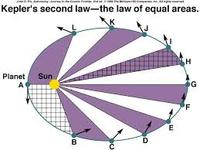
Where is the planet moving faster
Position A to B
Position B to C
Position H to I
Position I to J
Answer explanation
The planet moves faster between Position A to B due to its proximity to the sun, following Kepler's laws of planetary motion, which state that a planet travels faster when closer to the sun.
Tags
NGSS.HS-ESS1-4
6.
MULTIPLE CHOICE QUESTION
3 mins • 1 pt
According to Kepler's second law, in the picture which of the following is true for all of the purple sectors shown in the diagram
They are all show areas where the object is accelerating while the white sections show areas of constant velocity.
They all have the same area to show that they cover the same amount of displacement
They all have the same area to show that they take the same amount of time
They all go slow, as shown by the use of a darker color
Answer explanation
According to Kepler's second law, the purple sectors represent equal areas swept out in equal times, meaning they all have the same area to show that they take the same amount of time.
Tags
NGSS.HS-ESS1-4
7.
MULTIPLE CHOICE QUESTION
3 mins • 1 pt
If a moon’s orbital radius doubles, by what factor does its orbital period change ?
Use the following proportionality from Kepler's 3rd law:
The period increases by a factor of 2.82
The period decreases by a factor of 2.82
The period increases by a factor of 5.20
The period increases by a factor of 8.28
Answer explanation
According to Kepler's Third Law, the orbital period (T) is proportional to the 3/2 power of the orbital radius (r). If r doubles, T increases by a factor of (2^(3/2)) = 2.82. Thus, the correct choice is that the period increases by a factor of 2.82.
Tags
NGSS.HS-ESS1-4


Access all questions and much more by creating a free account
Create resources
Host any resource
Get auto-graded reports

Continue with Google

Continue with Email

Continue with Microsoft
or continue with

%20(1).png)
Apple

Others
By signing up, you agree to our Terms of Service & Privacy Policy
Already have an account?


