
7.7-2.4: Chemical Reactions Critical Juncture Assessment
Authored by Andrea Edwards
Science
7th Grade
NGSS covered
Used 8+ times


AI Actions
Add similar questions
Adjust reading levels
Convert to real-world scenario
Translate activity
More...
Content View
Student View
10 questions
Show all answers
1.
MULTIPLE CHOICE QUESTION
30 sec • 1 pt

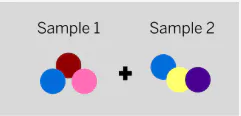
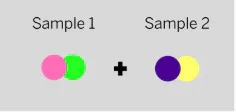
The diagram above shows the repeating groups of atoms that make up two samples. Will the properties of the two samples likely be the same or different? (Examples of properties are smell, color, and the temperature at which a substance melts.)
The properties will likely be different because there are more repeating groups of atoms in Sample 2.
The properties will likely be different because the repeating groups of atoms that make up each sample are different.
The properties will likely be the same because the repeating groups of atoms that make up the two samples have one of the same types of atoms.
The properties will likely be the same because the repeating groups of atoms that make up the two samples have the same number of atoms.
Tags
NGSS.MS-PS1-1
2.
MULTIPLE CHOICE QUESTION
30 sec • 1 pt

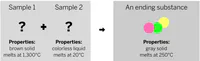
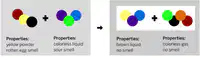
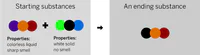
A scientist mixed two samples together: a colorless liquid that melts at 12°C and a yellow solid that melts at 390°C. She analyzed the results and found two ending substances. One of the ending substances was a gray solid. This ending substance is made up of the repeating group of atoms shown above. Which of the diagrams to the left shows the repeating groups of atoms that make up the samples the scientist mixed together?


Answer explanation

5. Key Concept
During a chemical reaction, one or more starting substances (reactants) change into one or more different substances (products).
6. Key Concept
During a chemical reaction, atoms do not change from one type to another.
7. Key Concept
During a chemical reaction, atoms rearrange to form different groups of atoms.
*Note - Each circle color represents a different element (type of atom)
*Note - two different substances can NOT have the exact same properties.
*Note - If two substances are different they must be made of different elements and/or numbers of elements (So different colors and/or number of circles)
Tags
NGSS.MS-PS1-1
NGSS.MS-PS1-2
NGSS.MS-PS1-5
3.
MULTIPLE CHOICE QUESTION
30 sec • 1 pt

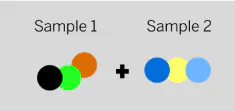
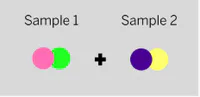
The diagram above shows the repeating groups of atoms that make up two samples. Both samples are gases at room temperature. Will the other properties of the samples likely be the same or different? (Examples of properties are smell, color, and the temperature at which a substance melts.)
The other properties will likely be the same because the repeating groups of atoms that make up the two samples have the same types of atoms.
The other properties will likely be the same because both samples are gases at room temperature.
The other properties will likely be different because there are more repeating groups of atoms in Sample 1.
The other properties will likely be different because the repeating groups of atoms that make up the two samples have different numbers of atoms.
Tags
NGSS.MS-PS1-1
4.
MULTIPLE CHOICE QUESTION
30 sec • 1 pt

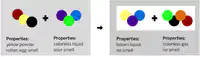
A scientist mixed two samples together: a white solid that boils at about 800°C and a colorless gas that boils at about 70°C. He analyzed the results and found two ending substances. One of the ending substances boils at 245°C. This ending substance is made up of the repeating group of atoms shown above. Which of the diagrams to the left shows the repeating groups of atoms that make up the samples the scientist mixed together?


Answer explanation

5. Key Concept
During a chemical reaction, one or more starting substances (reactants) change into one or more different substances (products).
6. Key Concept
During a chemical reaction, atoms do not change from one type to another.
7. Key Concept
During a chemical reaction, atoms rearrange to form different groups of atoms.
*Note - Each circle color represents a different element (type of atom)
*Note - two different substances can NOT have the exact same properties.
*Note - If two substances are different they must be made of different elements and/or numbers of elements (So different colors and/or number of circles)
Tags
NGSS.MS-PS1-1
NGSS.MS-PS1-2
5.
MULTIPLE CHOICE QUESTION
30 sec • 1 pt

The diagram above shows the repeating groups of atoms that make up two samples. Both samples are solids at room temperature. Will the other properties of the two samples likely be the same or different? (Examples of properties are smell, color, and the temperature at which a substance melts.)
The other properties will likely be different because there are more repeating groups of atoms in Sample 2.
The other properties will likely be different because the repeating groups of atoms that make up the two samples have different numbers of atoms.
The other properties will likely be the same because the repeating groups of atoms that make up the two samples have the same types of atoms.
The other properties will likely be the same because both samples are solids at room temperature.
Tags
NGSS.MS-PS1-1
6.
MULTIPLE CHOICE QUESTION
30 sec • 1 pt

Jacob mixed two samples together: a colorless gas with no smell and a colorless liquid that smells like bleach. He analyzed the results and found two ending substances. One of the ending substances was a green gas. This ending substance is made up of the repeating group of atoms shown above. Which of the diagrams to the left shows the repeating groups of atoms that make up the samples Jacob mixed together?


Answer explanation

5. Key Concept
During a chemical reaction, one or more starting substances (reactants) change into one or more different substances (products).
6. Key Concept
During a chemical reaction, atoms do not change from one type to another.
7. Key Concept
During a chemical reaction, atoms rearrange to form different groups of atoms.
*Note - Each circle color represents a different element (type of atom)
*Note - two different substances can NOT have the exact same properties.
*Note - If two substances are different they must be made of different elements and/or numbers of elements (So different colors and/or number of circles)
Tags
NGSS.MS-PS1-1
NGSS.MS-PS1-2
NGSS.MS-PS1-5
7.
MULTIPLE CHOICE QUESTION
30 sec • 1 pt

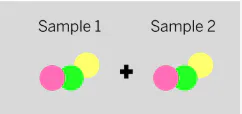
The diagram above shows the repeating groups of atoms that make up two samples. Both samples are red powdery solids at room temperature. Will the other properties of the two samples be the same or different? (Examples of properties are smell, color, and the temperature at which a substance melts.)
The other properties will be different because there are more repeating groups of atoms in Sample 1.
The other properties will be the same because both samples are red at room temperature.
The other properties will be the same because both samples are powdery solids at room temperature.
The other properties will be same because the repeating groups of atoms that make up the two samples are the same.
Tags
NGSS.MS-PS1-1

Access all questions and much more by creating a free account
Create resources
Host any resource
Get auto-graded reports

Continue with Google

Continue with Email

Continue with Classlink

Continue with Clever
or continue with

Microsoft
%20(1).png)
Apple

Others
Already have an account?



