
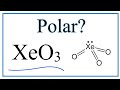
Polarity and Properties of Xenon Trioxide

Interactive Video
•
Chemistry
•
9th - 10th Grade
•
Practice Problem
•
Hard

Aiden Montgomery
FREE Resource
Read more
9 questions
Show all answers
1.
MULTIPLE CHOICE QUESTION
30 sec • 1 pt
What is the chemical formula for xenon trioxide?
XeO3
XeO2
XeO4
XeO5
2.
MULTIPLE CHOICE QUESTION
30 sec • 1 pt
How many electrons surround the xenon atom in xenon trioxide?
12
8
10
14
3.
MULTIPLE CHOICE QUESTION
30 sec • 1 pt
What is the significance of the expanded octet in xenon trioxide?
It allows xenon to bond with more oxygen atoms.
It makes xenon trioxide nonpolar.
It increases the electronegativity of xenon.
It reduces the number of lone pairs on oxygen.
4.
MULTIPLE CHOICE QUESTION
30 sec • 1 pt
What is the electronegativity value of xenon in xenon trioxide?
1.90
3.44
4.00
2.60
5.
MULTIPLE CHOICE QUESTION
30 sec • 1 pt
Why is the bond between xenon and oxygen in XeO3 considered polar?
Because xenon is more electronegative than oxygen.
Because oxygen is more electronegative than xenon.
Because they have the same electronegativity.
Because xenon has a lone pair.
6.
MULTIPLE CHOICE QUESTION
30 sec • 1 pt
How does the lone pair on xenon affect the geometry of XeO3?
It makes the molecule linear.
It makes the molecule symmetrical.
It pushes the oxygen atoms down, creating an asymmetrical shape.
It has no effect on the geometry.
7.
MULTIPLE CHOICE QUESTION
30 sec • 1 pt
What is the overall charge distribution in xenon trioxide?
The xenon side is negative, and the oxygen side is positive.
The molecule is nonpolar with no charge distribution.
The oxygen side is negative, and the xenon side is positive.
Both sides are equally charged.
Access all questions and much more by creating a free account
Create resources
Host any resource
Get auto-graded reports

Continue with Google

Continue with Email

Continue with Classlink

Continue with Clever
or continue with

Microsoft
%20(1).png)
Apple

Others
Already have an account?

