
Price elasticity of demand
Authored by Leanne Magree
Social Studies
10th Grade
Used 5+ times


AI Actions
Add similar questions
Adjust reading levels
Convert to real-world scenario
Translate activity
More...
Content View
Student View
10 questions
Show all answers
1.
MULTIPLE CHOICE QUESTION
30 sec • 1 pt
What does Price Elasticity of Demand (PED) show?
How much demand changes when price changes.
How much supply changes when price changes.
How much demand changes when income changes.
How much supply changes when income changes.
Answer explanation
Price Elasticity of Demand (PED) measures how much the quantity demanded of a good changes in response to a change in its price. Therefore, the correct choice is 'How much demand changes when price changes.'
2.
MULTIPLE CHOICE QUESTION
30 sec • 1 pt
If demand changes a lot with a small price change, what is this called?
Elastic demand
Inelastic demand
Unitary demand
Perfectly inelastic demand
Answer explanation
When demand changes significantly with a small price change, it is referred to as elastic demand. This indicates that consumers are sensitive to price changes, leading to a larger change in quantity demanded.
3.
MULTIPLE CHOICE QUESTION
30 sec • 1 pt
If the Price Elasticity of Demand (PED) is less than 1, what does this indicate?
Inelastic demand
Elastic demand
Unitary demand
Perfectly elastic demand
Answer explanation
If the Price Elasticity of Demand (PED) is less than 1, it indicates inelastic demand, meaning that consumers are less responsive to price changes. Thus, the correct choice is inelastic demand.
4.
MULTIPLE CHOICE QUESTION
30 sec • 1 pt
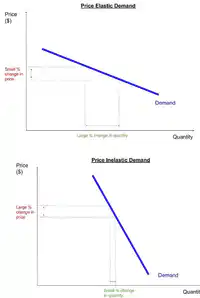
Which formula is used to calculate PED using the midpoint method?
(Q2-Q1)/(Q1+Q2)/2 divided by (P2-P1)/(P1+P2)/2
(Q2-Q1)/(P2-P1)
(P2-P1)/(Q2-Q1)
(Q1+Q2)/(P1+P2)
Answer explanation
The correct formula for calculating Price Elasticity of Demand (PED) using the midpoint method is (Q2-Q1)/(Q1+Q2)/2 divided by (P2-P1)/(P1+P2)/2, as it averages the changes in quantity and price.
5.
MULTIPLE CHOICE QUESTION
30 sec • 1 pt
A product’s price increases by 10%, and its quantity demanded decreases by 20%. Based on the PED formula, is the demand elastic or inelastic? (Show your reasoning.)
Elastic, because PED > 1
Inelastic, because PED < 1
Unitary, because PED = 1
Perfectly inelastic, because PED = 0
Answer explanation
To calculate the Price Elasticity of Demand (PED), use the formula: PED = % change in quantity demanded / % change in price. Here, PED = -20% / 10% = -2. Since the absolute value is greater than 1, demand is elastic.
6.
MULTIPLE CHOICE QUESTION
30 sec • 1 pt
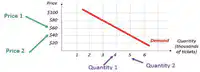
What does PED stand for in economics?
Price Elasticity of Demand
Product Elasticity of Demand
Price Efficiency of Demand
Product Efficiency of Demand
Answer explanation
In economics, PED stands for Price Elasticity of Demand, which measures how the quantity demanded of a good responds to a change in its price. This concept is crucial for understanding consumer behavior and market dynamics.
7.
MULTIPLE CHOICE QUESTION
30 sec • 1 pt
Which of the following is likely to be a product with elastic demand?
Movie tickets
Petrol (Gasoline)
Bread
Salt
Answer explanation
Movie tickets have elastic demand because they are a luxury item with many substitutes. When prices rise, consumers can easily choose other entertainment options, unlike essential goods like petrol, bread, or salt.
Access all questions and much more by creating a free account
Create resources
Host any resource
Get auto-graded reports

Continue with Google

Continue with Email

Continue with Classlink

Continue with Clever
or continue with

Microsoft
%20(1).png)
Apple

Others
Already have an account?


