
20250819 Stiff fingers Dr Thivagar
Authored by TSara Ahmad
Other
University
Used 1+ times


AI Actions
Add similar questions
Adjust reading levels
Convert to real-world scenario
Translate activity
More...
Content View
Student View
5 questions
Show all answers
1.
MULTIPLE CHOICE QUESTION
1 min • 1 pt
When performing the Bunnell test, you note that there is more flexion of the PIPJ when the MCPJ is flexed. This indicates tightness of:
A. Checkrein Ligaments
B. Volar Plate
C. Lumbricals
D. Extensor Tendon
2.
MULTIPLE CHOICE QUESTION
1 min • 1 pt
After releasing the checkrein ligaments for a PIPJ flexion contracture release, you note a persistent flexion contracture. What do you do next?
A. Release the accessory collateral ligament
B. Release The collateral ligament
C. Divide the A3 Pulley
D. Sacrifice the flexor digitorum superficialis tendon
3.
MULTIPLE CHOICE QUESTION
1 min • 1 pt
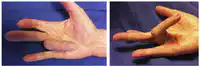
A 30 year old gentleman presents to you with the flexion contracture below. Active extension and passive extension range of movement are similar. He is able to fully flex the ring finger
without pain. What is the most likely pathology?
A. Intrinsic tightness
B. Oblique Retinacular Ligament tightness
C. Volar plate contracture
D. Central Slip rupture
4.
MULTIPLE CHOICE QUESTION
1 min • 1 pt
Which of the following statement is correct?
A. Collateral ligaments are loose at MCPJ flexion, tighten during increasing extension.
B. Volar plate helps prevent hyperflexion of MCPJ and PIPJ
C. Lax collateral ligament can cause swan neck deformity
D. Collateral ligaments are the main stabilizer to the abduction and adduction stress of MCPJ
5.
MULTIPLE CHOICE QUESTION
1 min • 1 pt
Why is the metacarpophalangeal (MP) joint particularly affected during early post-injury edema?
A. It has minimal capsular laxity in extension
B. It is stabilized in flexion by intrinsic muscles
C. Its intracapsular volume is maximal in extension, encouraging fluid accumulation
D. It is structurally resistant to hydrostatic pressure
Access all questions and much more by creating a free account
Create resources
Host any resource
Get auto-graded reports

Continue with Google

Continue with Email

Continue with Classlink

Continue with Clever
or continue with

Microsoft
%20(1).png)
Apple

Others
Already have an account?


