
- Resource Library
- Science
- Chemistry
- Conservation Of Mass
- Investigating Conservation Of Mass In Chemical Reactions
Investigating Conservation of Mass in Chemical Reactions
Authored by GISELLE DIAZ
Science
6th Grade
NGSS covered
Used 1+ times


AI Actions
Add similar questions
Adjust reading levels
Convert to real-world scenario
Translate activity
More...
Content View
Student View
38 questions
Show all answers
1.
MULTIPLE CHOICE QUESTION
30 sec • 1 pt
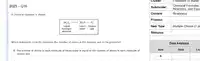
A chemical equation is shown. 2H2O2 (liquid hydrogen peroxide) → 2H2O (liquid water) + O2 (oxygen gas) Which statement correctly compares the number of atoms in the reactant and in the products?
The number of atoms in each molecule of liquid water is equal to the number of atoms in each molecule of oxygen gas.
The number of atoms in each molecule of hydrogen peroxide is equal to the number of atoms in each molecule of oxygen gas.
The total number of atoms in the hydrogen peroxide molecules is equal to the total number of atoms in the liquid water and oxygen gas molecules.
The total number of atoms in the hydrogen peroxide molecules is equal to the total number of atoms in each molecule of liquid water.
Tags
NGSS.MS-PS1-2
NGSS.MS-PS1-5
2.
DROPDOWN QUESTION
1 min • 1 pt

What is the student MOST LIKELY to discover about the mass of the ring and solution after the ring is removed from the pan?
The mass of the ring will (a) . The mass of the solution will (b) . The total mass of the ring and the solution will (c) .
Cannot be determined
Tags
NGSS.MS-PS1-2
NGSS.MS-PS1-5
3.
MULTIPLE CHOICE QUESTION
30 sec • 1 pt
An equation for a chemical reaction is shown. NaOH + HCl → NaCl + H₂O Which statement provides evidence that mass is conserved in the reaction?
Two new substances are formed in the products.
Water is one of the products, but not one of the reactants.
Two hydrogen atoms are in the reactants, and two hydrogen atoms are in the products.
One chlorine atom pairs with one sodium atom in the products, and one chlorine atom pairs with one hydrogen atom in the reactants.
Tags
NGSS.MS-PS1-5
4.
MULTIPLE CHOICE QUESTION
1 min • 1 pt

How many grams of sulfuric acid were used in the reaction?
62 g
98 g
36 g
100 g
Tags
NGSS.MS-PS1-2
NGSS.MS-PS1-5
5.
MULTIPLE CHOICE QUESTION
30 sec • 1 pt
Which statement describes an action that most likely resulted in a chemical reaction?
A. A pan of water was heated on a stove, and steam formed.
B. A liquid was mixed with another liquid, and a precipitate formed.
C. A liquid was sprayed into the air, and a sweet odor was smelled.
D. A child blew through a wand filled with soap, and bubbles were produced.
Tags
NGSS.MS-PS1-2
6.
MULTIPLE CHOICE QUESTION
30 sec • 1 pt
The chemical formula for acetic acid is CH3COOH. How many hydrogen atoms are in one molecule of acetic acid?
3
4
5
6
Tags
NGSS.MS-PS1-1
7.
MULTIPLE CHOICE QUESTION
1 min • 1 pt
Which statement is an accurate comparison of the formula for ammonia (NH₃) and the formula for sodium hydroxide (NaOH)?
The formula for sodium hydroxide has more atoms and more elements than the formula for ammonia.
The formula for ammonia has more atoms and more elements than the formula for sodium hydroxide.
The formula for sodium hydroxide has more atoms, but the formula for ammonia has more elements.
The formula for ammonia has more atoms, but the formula for sodium hydroxide has more elements.
Tags
NGSS.MS-PS1-1
Access all questions and much more by creating a free account
Create resources
Host any resource
Get auto-graded reports

Continue with Google

Continue with Email

Continue with Microsoft
or continue with

%20(1).png)
Apple

Others
By signing up, you agree to our Terms of Service & Privacy Policy
Already have an account?


