
Unit 2 Lesson 3 Practice Problems
Authored by Alicia Brock
Mathematics
6th Grade
CCSS covered


AI Actions
Add similar questions
Adjust reading levels
Convert to real-world scenario
Translate activity
More...
Content View
Student View
14 questions
Show all answers
1.
MULTIPLE CHOICE QUESTION
30 sec • 1 pt
Which of the following explains why the ratios 4 : 5 and 8 : 10 are equivalent ratios?
Because multiplying both terms of 4 : 5 by 2 gives 8 : 10
Because 4 + 5 equals 8 + 10
Because 4 : 5 is the same as 5 : 4
Because 8 : 10 is double 4 : 10
Tags
CCSS.6.RP.A.3A
2.
MULTIPLE CHOICE QUESTION
30 sec • 1 pt
Which of the following explains why the ratios 18 : 3 and 6 : 1 are equivalent?
Both ratios simplify to the same value when divided.
18 : 3 is greater than 6 : 1.
6 : 1 is double 18 : 3.
The numbers in both ratios are consecutive multiples.
Tags
CCSS.6.RP.A.3A
3.
MULTIPLE CHOICE QUESTION
30 sec • 1 pt
Which of the following explains why the ratios 2 : 7 and 10,000 : 35,000 are equivalent?
Both ratios simplify to the same simplest form.
Both ratios have the same sum of terms.
Both ratios have the same difference between terms.
Both ratios have the same product of terms.
Tags
CCSS.6.RP.A.3A
4.
MULTIPLE CHOICE QUESTION
30 sec • 1 pt
6 : 4 and 18 : 8 are not equivalent ratios because:
Their simplest forms are different.
They have the same simplest form.
Both ratios are equal to 3:2.
Both ratios can be reduced to 9:4.
Tags
CCSS.6.RP.A.3A
5.
MULTIPLE CHOICE QUESTION
30 sec • 1 pt
The ratios 3 : 6 and 6 : 3 are equivalent. Why or why not?
No, because the order of numbers in a ratio matters.
Yes, because both ratios have the same numbers.
Yes, because both ratios simplify to the same value.
No, because the numbers are different.
Tags
CCSS.6.RP.A.3A
6.
MULTIPLE CHOICE QUESTION
30 sec • 1 pt
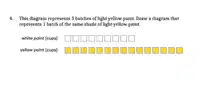
Which diagram represents 1 batch of the same shade of light yellow paint?
A container with 9 white and 15 yellow
A container with 10 white and 14 yellow
A container with 35 white and 100 yellow
A container with 3 white and 5 yellow
Tags
IA.MATH.3.NF.A.2.b
IA.MATH.3.NF.A.1
7.
MULTIPLE CHOICE QUESTION
30 sec • 1 pt
In the fruit bowl there are 6 bananas, 4 apples, and 3 oranges. a. For every 4 ________________, there are 3 ________________.
For every 4 apples, there are 3 oranges.
For every 4 bananas, there are 3 apples.
For every 4 oranges, there are 3 bananas.
For every 4 apples, there are 3 bananas.
Access all questions and much more by creating a free account
Create resources
Host any resource
Get auto-graded reports

Continue with Google

Continue with Email

Continue with Classlink

Continue with Clever
or continue with

Microsoft
%20(1).png)
Apple

Others
Already have an account?

