
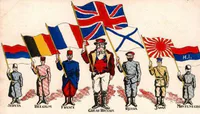
Nationalism and Its Historical Impact

Interactive Video
•
Social Studies
•
10th Grade
•
Practice Problem
•
Hard

Antone Lopez
Used 3+ times
FREE Resource
9 questions
Show all answers
1.
MULTIPLE CHOICE QUESTION
30 sec • 1 pt
How did most people identify themselves before the late 18th century?
As citizens of a nation-state.
Primarily with their family, village, or religious community.
As subjects of a monarch or emperor.
Both B and C.
2.
MULTIPLE CHOICE QUESTION
30 sec • 1 pt
What is nationalism?
A belief that state borders should match the homeland of a people.
An ideology that allows millions of strangers to care about one another and share common goals.
An ideology that combines cultural beliefs about the existence of nations with political claims for their self-governance.
A system where people are governed by a monarch or emperor.
3.
MULTIPLE CHOICE QUESTION
30 sec • 1 pt
What is Benedict Anderson's definition of a nation?
A group of people united by a common language and history.
A sovereign state with clearly defined geographical boundaries.
An imagined political community.
A collection of individuals who have met each other and share common goals.
4.
MULTIPLE CHOICE QUESTION
30 sec • 1 pt
What historical period is identified as the beginning of modern nationalism?
The Age of Exploration.
The Atlantic Revolutions of the late 18th and early 19th centuries.
The Industrial Revolution.
The Renaissance.
5.
MULTIPLE CHOICE QUESTION
30 sec • Ungraded
Are you enjoying the video lesson?
Yes
No
6.
MULTIPLE CHOICE QUESTION
30 sec • 1 pt
How did the development of nationalism in France differ from that in Italy and Germany during the 19th century?
France experienced straightforward nationalism due to a centralized government and defined borders, while Italy and Germany faced challenges unifying many smaller states.
France struggled with internal ethnic divisions, whereas Italy and Germany easily formed unified nations.
Nationalism in France was primarily driven by economic factors, unlike the cultural movements in Italy and Germany.
France resisted nationalist movements, while Italy and Germany embraced them to expand their empires.
7.
MULTIPLE CHOICE QUESTION
30 sec • 1 pt
What role did nationalism play in the outbreak of World War I?
It led to a global economic depression that destabilized international relations.
It fostered increased cooperation among European powers, leading to alliances.
It contributed to the assassination of the Austrian Archduke by a Serbian nationalist and heightened competition among European nations.
It promoted pacifist movements that sought to prevent large-scale conflicts.
Access all questions and much more by creating a free account
Create resources
Host any resource
Get auto-graded reports

Continue with Google

Continue with Email

Continue with Classlink

Continue with Clever
or continue with

Microsoft
%20(1).png)
Apple

Others
Already have an account?

