
Weather Test Review
Authored by Malinda Dackiw
Science
8th Grade
NGSS covered
Used 2+ times


AI Actions
Add similar questions
Adjust reading levels
Convert to real-world scenario
Translate activity
More...
Content View
Student View
33 questions
Show all answers
1.
MULTIPLE CHOICE QUESTION
30 sec • 1 pt
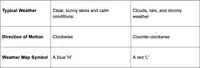
On weather maps, which symbol marks a high-pressure system?
A red 'L'
A blue 'H'
A green triangle
A yellow sun
Answer explanation
On weather maps, a blue 'H' indicates a high-pressure system, while a red 'L' marks a low-pressure system. The other options, a green triangle and a yellow sun, do not represent pressure systems.
2.
MULTIPLE CHOICE QUESTION
30 sec • 1 pt
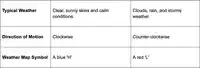
Typical weather under a low-pressure system is most likely to be:
Clear, sunny, and calm
Clouds, rain, and stormy
Dry and hot
Cold and windless
Answer explanation
Low-pressure systems are associated with rising air, which cools and condenses to form clouds and precipitation. Therefore, typical weather under a low-pressure system is characterized by clouds, rain, and stormy conditions.
Tags
NGSS.MS-ESS2-5
NGSS.MS-ESS2-6
3.
MULTIPLE CHOICE QUESTION
30 sec • 1 pt
What is the general rule for wind described in the text?
Wind is air flowing from low pressure to high pressure
Wind is air flowing from high pressure to low pressure
Wind only occurs over oceans
Wind is caused by Earth's rotation alone
Answer explanation
The correct choice is that wind is air flowing from high pressure to low pressure. This is a fundamental principle of meteorology, as air moves to equalize pressure differences, creating wind.
Tags
NGSS.MS-ESS2-6
4.
MULTIPLE CHOICE QUESTION
30 sec • 1 pt
Why does warm air tend to rise, according to the passage?
Warm air is denser because molecules pack closely
Warm air expands and becomes less dense
Warm air is pushed up by precipitation
Warm air contains more moisture
Answer explanation
Warm air tends to rise because it expands and becomes less dense than cooler air. This lower density allows it to rise, while denser, cooler air sinks, creating convection currents.
5.
MULTIPLE CHOICE QUESTION
30 sec • 1 pt
At night near a coastline, which breeze occurs and in which direction does the air move?
Sea breeze; from sea to land
Land breeze; from sea to land
Sea breeze; from land to sea
Land breeze; from land to sea
Answer explanation
At night, the land cools faster than the sea, causing the air over the land to become denser and sink. This creates a land breeze, which moves air from land to sea.
Tags
NGSS.MS-ESS2-5
6.
MULTIPLE CHOICE QUESTION
30 sec • 1 pt
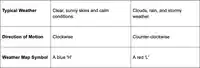
Which feature is typical of a high-pressure system?
Moist air that condenses
Air comes together and rises
Clear, sunny skies and calm conditions
Counter-clockwise motion
Answer explanation
A high-pressure system is characterized by descending air, leading to clear, sunny skies and calm conditions. This contrasts with low-pressure systems, which typically bring moist air that condenses and stormy weather.
Tags
NGSS.MS-ESS2-5
7.
MULTIPLE CHOICE QUESTION
30 sec • 1 pt
What do scientists who forecast weather by analyzing atmospheric components call themselves?
Climatologists
Geologists
Meteorologists
Oceanographers
Answer explanation
Scientists who forecast weather by analyzing atmospheric components are called meteorologists. They specialize in studying the atmosphere and its phenomena, unlike climatologists, geologists, or oceanographers who focus on different fields.
Tags
NGSS.MS-ESS2-5
NGSS.MS-ESS2-6
Access all questions and much more by creating a free account
Create resources
Host any resource
Get auto-graded reports

Continue with Google

Continue with Email

Continue with Classlink

Continue with Clever
or continue with

Microsoft
%20(1).png)
Apple

Others
Already have an account?



