
Chapter 11: Air Carriers Introduction and Deregulation Impact
Authored by Matthew Ernst
Other
10th Grade
Used 1+ times


AI Actions
Add similar questions
Adjust reading levels
Convert to real-world scenario
Translate activity
More...
Content View
Student View
15 questions
Show all answers
1.
MULTIPLE CHOICE QUESTION
30 sec • 1 pt
Before 1978, which agency strictly regulated airline fares and routes, requiring approval for fare changes and restricting airlines to certain routes?
Federal Aviation Administration (FAA)
Civil Aeronautics Board (CAB)
Department of Transportation (DOT)
International Air Transport Association (IATA)
2.
MULTIPLE CHOICE QUESTION
30 sec • 1 pt
Which Boeing 747 variant is described as the heaviest aircraft, commercial or military, with a maximum take-off weight of 975,000 lb?
747-400
747-8
787-8F
767-300
3.
MULTIPLE CHOICE QUESTION
30 sec • 1 pt
Which Airbus model is noted for being the first four-engine, long-range aircraft for Airbus and is not as large as the Boeing 747?
A300B
A330
A340
A380
4.
MULTIPLE CHOICE QUESTION
30 sec • 1 pt
Which characteristic distinguishes the Boeing 767 from the 747 in typical configurations described?
The 767 is wider than the 747 and carries over 500 passengers.
The 767 is a twin-engine, wide-body jetliner that is narrower and shorter than the 747.
The 767 has a maximum takeoff weight more than twice that of the 747.
The 767 introduced double-slotted inboard flaps.
5.
MULTIPLE CHOICE QUESTION
30 sec • 1 pt
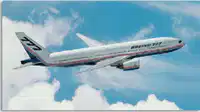
Which Boeing 777 model is capable of flying up to 8,861 miles and was first delivered in February 1997?
777-200
777-200ER
777-300
787 Dreamliner
6.
MULTIPLE CHOICE QUESTION
30 sec • 1 pt
An airline needs a short-range jet that can operate from runways as short as 4,000 feet and offers parts interchangeability with the 727. Which aircraft best meets these needs?
Boeing 737
Boeing 757
McDonnell-Douglas MD-90
Boeing 717
7.
MULTIPLE CHOICE QUESTION
30 sec • 1 pt
Which statement best describes a key advantage of hub-and-spoke airline networks compared to point-to-point systems?
They minimize travel time between any two city pairs without connections.
They allow airlines to consolidate maintenance and ground services and offer more destination choices via synchronized arrivals and departures.
They avoid ripple effects from weather disruptions because flights operate independently.
They require fewer gate positions and less airport infrastructure than point-to-point.
Access all questions and much more by creating a free account
Create resources
Host any resource
Get auto-graded reports

Continue with Google

Continue with Email

Continue with Classlink

Continue with Clever
or continue with

Microsoft
%20(1).png)
Apple

Others
Already have an account?



