
APES Unit 4 HW #3 (Quiz) — Extracted Questions
Authored by Stephanie Castro
Science
12th Grade
NGSS covered
Used 4+ times


AI Actions
Add similar questions
Adjust reading levels
Convert to real-world scenario
Translate activity
More...
Content View
Student View
20 questions
Show all answers
1.
MULTIPLE CHOICE QUESTION
1 min • 1 pt
Which of the following abiotic factors, when graphed on the x-axis, leads to the curved line in the graph due to variation in different layers of the atmosphere?
Nitrogen N2 concentration gradients
Carbon dioxide CO2 concentration gradients
Temperature gradients
Ultraviolet radiation gradients
Tags
NGSS.MS-ESS2-6
2.
MULTIPLE CHOICE QUESTION
1 min • 1 pt
The vast majority of ozone is found in a thin layer due to a lack of circulation in which of the following atmospheric layers?
Thermosphere
Mesosphere
Stratosphere
Troposphere
3.
MULTIPLE CHOICE QUESTION
1 min • 1 pt
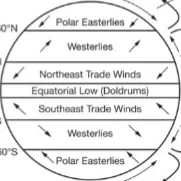
A model of prevailing wind patterns around the world is shown in the diagram below. Which of the following is the best explanation for the formation of Hadley cells in the tropics, as seen in the diagram between 30 N and 30 S latitude?
Heat from the ocean warms the most air at the equator and causes it to rise because of its lower density. As the air becomes cooler, it becomes less dense and sinks.
The Sun warms the most air at the equator and causes it to rise because of its lower density. As the warm air moves away from the equator, it cools, becomes denser, and then sinks.
Air cools over the land at the equator and then rises as it moves north or south.
Rising air over the equator is heated by the Sun, moves north, and then moves south to create the jet stream and trade winds.
Tags
NGSS.MS-ESS2-6
4.
MULTIPLE CHOICE QUESTION
1 min • 1 pt
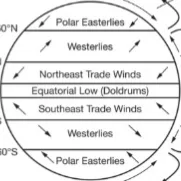
A model of prevailing wind patterns around the world is shown in the diagram above. Which of the following is the best explanation for the deflection of the trade winds in both hemispheres, as seen in the diagram above?
The wind is deflected east because of varying landmasses at the latitudes.
The wind is deflected east because of the waves in the ocean.
The wind is deflected west because of the mountains that the air encounters as the wind moves north or south.
The wind is deflected west because of Earth’s rotation.
Tags
NGSS.MS-ESS2-6
5.
MULTIPLE CHOICE QUESTION
1 min • 1 pt
Based on the diagram, which of the following days in Earth’s yearly orbit would have the longest period of daylight in the Northern Hemisphere?
March equinox
December solstice
September equinox
June solstice
Tags
NGSS.MS-ESS1-1
6.
MULTIPLE CHOICE QUESTION
1 min • 1 pt
Which statement is best illustrated in the diagram above regarding how the Sun’s energy affects the Earth’s surface from June through September in the Northern Hemisphere?
The season changes from autumn to winter, daylight hours decrease, and infrared radiation is the weakest during the September equinox.
The season changes from winter to spring, daylight hours increase and infrared radiation is the weakest during the June solstice.
The season changes from summer to autumn, daylight hours decrease, and infrared radiation is the strongest during the June solstice.
The season changes from spring to summer, daylight hours increase, and infrared radiation is the strongest during the September equinox.
Tags
NGSS.MS-ESS2-6
NGSS.MS-ESS1-1
7.
MULTIPLE CHOICE QUESTION
1 min • 1 pt
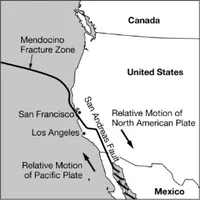
Which of the following statements best describes the boundary between the two tectonic plates seen in the map?
The map illustrates a convergent boundary, where tectonic plates collide, and the North American Plate is sliding under the Pacific Plate.
The map illustrates a divergent boundary, where two tectonic plates are moving away from each other, creating a rift valley.
The map illustrates a transform boundary, where tectonic plates slide past each other as the Pacific Plate moves northwest and the North American Plate move southeast.
The map illustrates a subduction zone at the boundary, leading to the formation of long chain of volcanoes.
Tags
NGSS.MS-ESS2-3
Access all questions and much more by creating a free account
Create resources
Host any resource
Get auto-graded reports

Continue with Google

Continue with Email

Continue with Classlink

Continue with Clever
or continue with

Microsoft
%20(1).png)
Apple

Others
Already have an account?


