
States of Matter Particle Models
Authored by s. Carpenter
Science
6th Grade
NGSS covered


AI Actions
Add similar questions
Adjust reading levels
Convert to real-world scenario
Translate activity
More...
Content View
Student View
42 questions
Show all answers
1.
MULTIPLE CHOICE QUESTION
30 sec • 1 pt
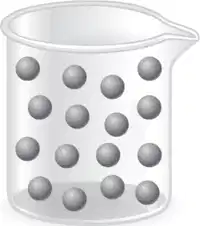
The image shows three samples of the same substance. Each sample has the same number of particles and weighs 1 gram. Study the spacing and arrangement of the particles in each sample to identify what is represented. Sample 1 is a ______ because the particles ______. Which terms best complete the sentence?
gas; move freely
gas; vibrate in place
solid; are loosely connected
liquid; move freely
Tags
NGSS.MS-PS1-4
2.
MULTIPLE CHOICE QUESTION
30 sec • 1 pt
The image shows three samples of the same substance. Each sample has the same number of particles and weighs 1 gram. Study the spacing and arrangement of the particles in each sample to identify its state of matter. Sample 2 is ______. Sample 3 is a ______. Which of the following terms, in order, best complete the sentences?
gas; liquid
solid; liquid
liquid; solid
liquid; gas
3.
MULTIPLE CHOICE QUESTION
30 sec • 1 pt
Study each sample in order to describe its mass, shape, and volume. Only sample 2 has a definite ________. Only samples 2 and 3 have a definite ________. All three samples have a definite ________. Which terms, in order of appearance, best complete the sentences?
shape; volume; mass
mass; shape; volume
shape; mass; volume
mass; volume; shape
4.
MULTIPLE CHOICE QUESTION
30 sec • 1 pt
Consider the relative kinetic energy of the particles in each sample. The particles in Sample 1 have _______ kinetic energy than the particles in Sample 2. The particles in Sample 1 have _______ kinetic energy than the particles in Sample 3. The particles in Sample 2 have _______ kinetic energy than the particles in Sample 3. Which terms, in order of appearance, best complete these sentences?
greater; the less; the same
greater; greater; less
less; less; greater
less; the same; less
Tags
NGSS.MS-PS3-5
NGSS.MS-PS3-1
NGSS.MS-PS3-4
5.
MULTIPLE SELECT QUESTION
30 sec • 1 pt
What is the same about the three samples of the substance? Select two answers.
Kinetic energy
Mass
Number of particles
Temperature
Tags
NGSS.MS-PS1-5
6.
MULTIPLE SELECT QUESTION
30 sec • 1 pt
What are the differences between pure substances and mixtures? Select three answers.
Pure substances have the same properties throughout, but the parts of a mixture can have different properties.
Pure substances cannot be physically separated, but mixtures can be separated.
Pure substances contain just one type of particle, and mixtures contain more than one type of particle.
Pure substances do not have a uniform composition and mixtures always have a uniform composition.
7.
MULTIPLE CHOICE QUESTION
30 sec • 1 pt
What is the difference between homogeneous mixtures and heterogeneous mixtures?
Homogeneous mixtures can be easily separated, and heterogeneous mixtures cannot be easily separated.
Homogeneous mixtures can be identified by properties, and heterogeneous mixtures cannot be identified by properties.
Homogeneous mixtures contain one substance, and heterogeneous mixtures contain more than one substance.
Homogeneous mixtures have a uniform composition, and heterogeneous mixtures do not have a uniform composition.
Access all questions and much more by creating a free account
Create resources
Host any resource
Get auto-graded reports

Continue with Google

Continue with Email

Continue with Microsoft
or continue with

%20(1).png)
Apple

Others
By signing up, you agree to our Terms of Service & Privacy Policy
Already have an account?


