
- Resource Library
- Science
- Physics
- Potential Energy Diagrams
- Unit 3 Exp. 2 Savvas Other Types Of Potential Energy
Unit 3 Exp. 2 SAVVAS Other Types of Potential Energy
Authored by Melinda Jackson
Science
6th Grade


AI Actions
Add similar questions
Adjust reading levels
Convert to real-world scenario
Translate activity
More...
Content View
Student View
8 questions
Show all answers
1.
MULTIPLE SELECT QUESTION
30 sec • 1 pt
Which terms complete the sentences? __________ is the energy that a material stores due to its deformation. __________ describes energy that is stored in bonds between atoms.
Kinetic energy, Gravitational potential energy
Chemical potential energy, Kinetic energy
Elastic potential energy, Chemical potential energy
Light energy, Chemical potential energy
2.
MULTIPLE CHOICE QUESTION
30 sec • 1 pt

The diagram shows a rubber band in two different states. Which of the following statements describes the diagram most accurately?
The rubber band on the left has more kinetic energy than the one on the right.
The rubber band on the right has more kinetic energy than the one on the left.
The rubber band on the right has more elastic potential energy than the one on the left.
The rubber band on the left has more elastic potential energy than the one on the right.
3.
MULTIPLE CHOICE QUESTION
30 sec • 1 pt
Suppose chemists in a lab are trying to release as much energy as possible from a chemical reaction. Which of the following options best represents a valid idea that will allow them to achieve their goal?
The chemists increase the temperature, which leads to more molecules forming bonds.
The chemists increase the amount of space where the reaction occurs, which leads to more molecules colliding and forming bonds.
The chemists increase the stability of the bonds in molecules, which makes it harder to release energy.
The chemists decrease the stability of bonds in molecules, which makes it easier for energy to be released.
4.
MULTIPLE CHOICE QUESTION
30 sec • 1 pt

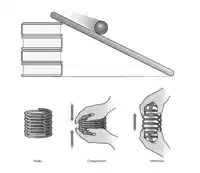
Kinetic energy is shown in _________. Elastic potential energy is shown in _________.
A. A; B
B. B; A
C. A; A
D. B; B
5.
MULTIPLE CHOICE QUESTION
30 sec • 1 pt

Based on the diagrams of a marble ramp and a spring in different states, which statement best explains the difference between kinetic energy and elastic potential energy?
Kinetic energy is the energy of motion, as seen with the moving marble, while elastic potential energy is stored in objects like compressed or stretched springs.
Kinetic energy is stored in objects at rest, while elastic potential energy is only found in liquids.
Elastic potential energy is the energy of motion, while kinetic energy is stored in stretched objects.
Kinetic energy and elastic potential energy are the same and cannot be distinguished.
6.
MULTIPLE CHOICE QUESTION
30 sec • 1 pt
Kinetic and elastic potential energy can be compared and contrasted using the diagrams discovered by the students. Which statement best summarizes their differences?
Kinetic energy is energy of motion, while elastic potential energy is stored in stretched or compressed objects.
Kinetic energy is stored in objects at rest, while elastic potential energy is energy of motion.
Both kinetic and elastic potential energy are only present in moving objects.
Elastic potential energy is only found in liquids, while kinetic energy is only found in solids.
7.
MULTIPLE CHOICE QUESTION
30 sec • 1 pt

Describe how chemical energy is depicted in the diagram. How is that chemical energy changed into kinetic energy?
Chemical energy is shown as stored energy in molecules and is changed into kinetic energy through a process such as combustion or cellular respiration.
Chemical energy is shown as light energy and is changed into kinetic energy by absorbing sunlight.
Chemical energy is depicted as electrical energy and is changed into kinetic energy by using a battery.
Chemical energy is shown as sound energy and is changed into kinetic energy by producing vibrations.
Access all questions and much more by creating a free account
Create resources
Host any resource
Get auto-graded reports

Continue with Google

Continue with Email

Continue with Microsoft
or continue with

%20(1).png)
Apple

Others
By signing up, you agree to our Terms of Service & Privacy Policy
Already have an account?



