
Introduction to Social Psychology
Authored by Jennifer Smith
Social Studies
University


AI Actions
Add similar questions
Adjust reading levels
Convert to real-world scenario
Translate activity
More...
Content View
Student View
30 questions
Show all answers
1.
MULTIPLE CHOICE QUESTION
30 sec • 1 pt
According to the material on Attribution Theory, which dimension contrasts believing outcomes come from personal factors with believing they come from outside circumstances?
Stability
Locus of control
Controllability
Cognitive dissonance
2.
MULTIPLE CHOICE QUESTION
30 sec • 1 pt
Which pairing correctly matches an attribution dimension with its poles as described: stability (consistent vs. changing), controllability (yes vs. no), and locus of control (internal vs. external)?
Stability: controllable vs. uncontrollable; Controllability: internal vs. external; Locus of control: consistent vs. changing
Stability: consistent vs. changing; Controllability: yes vs. no; Locus of control: internal vs. external
Stability: internal vs. external; Controllability: consistent vs. changing; Locus of control: yes vs. no
Stability: fixed vs. flexible; Controllability: effort vs. ability; Locus of control: individual vs. group
3.
MULTIPLE CHOICE QUESTION
30 sec • 1 pt
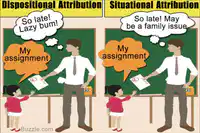
A teacher says, "So late! Lazy bum!" after a student turns in a late assignment. Based on the notes on applying Attribution Theory to others, what type of explanation is the teacher using?
Situational attribution, focusing on environmental constraints
Dispositional attribution, focusing on internal traits
Interactionist attribution, blending situational and dispositional causes
Self-serving bias, protecting one's self-esteem
4.
MULTIPLE CHOICE QUESTION
30 sec • 1 pt
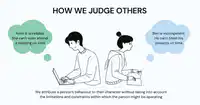
Which statement best reflects the Fundamental Attribution Error as described?
People in all cultures primarily blame situations when judging others' behavior.
In the U.S., people often overemphasize internal traits and underemphasize situational factors when judging others.
Collectivist cultures are more prone to dispositional attributions than individualistic cultures.
The error occurs only when judging our own behavior, not others'.
5.
MULTIPLE CHOICE QUESTION
30 sec • 1 pt
A friend misses a meeting. Which inference aligns with a situational attribution emphasized in social psychology?
They are irresponsible because they never plan ahead.
They lacked willpower, showing a stable character flaw.
There may have been constraints, such as a family emergency or transit delay.
Their personality is unreliable across contexts.
6.
MULTIPLE CHOICE QUESTION
30 sec • 1 pt
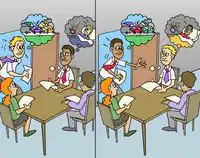
Which statement best defines the actor–observer bias as depicted in the meeting illustration: when judging others’ lateness, people attribute it to internal traits, but when judging their own lateness, they attribute it to situational constraints?
We explain both our own and others’ behavior mainly by external forces like traffic or weather.
We attribute others’ behavior to internal causes but our own behavior to external, situational causes.
We give equal weight to internal dispositions and external situations for everyone.
We attribute our own behavior to stable traits while others’ behavior to unstable situations.
7.
MULTIPLE CHOICE QUESTION
30 sec • 1 pt
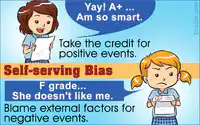
According to the description of self-serving bias, how are successes and failures typically explained?
Successes are explained by external luck, and failures by internal lack of ability.
Successes are explained by internal dispositions, and failures by external factors.
Both successes and failures are explained by stable, uncontrollable causes.
Successes and failures are both explained by situational pressures to protect group harmony.
Access all questions and much more by creating a free account
Create resources
Host any resource
Get auto-graded reports

Continue with Google

Continue with Email

Continue with Classlink

Continue with Clever
or continue with

Microsoft
%20(1).png)
Apple

Others
Already have an account?

