
Animal Evolution test
Authored by Brieana Toledo
Science
9th Grade
NGSS covered
Used 17+ times


AI Actions
Add similar questions
Adjust reading levels
Convert to real-world scenario
Translate activity
More...
Content View
Student View
24 questions
Show all answers
1.
MULTIPLE SELECT QUESTION
45 sec • 1 pt
Which characteristics demonstrate that sea anemones are animals and not plants? Select two that apply.
A.
The cells do not contain a membrane-bound nucleus; that is, they are prokaryotic.
B.
The organism depends on other organisms for nutrition; that is, it is heterotrophic
C.
The organism does not have cell walls, which are rigid structures that provide support and protection.
D.
The organism consists of cells that perform chemosynthesis.
2.
MULTIPLE SELECT QUESTION
45 sec • 1 pt
An animal society can offer a range of advantages to its members. Select the three examples that describe benefits of living in groups.
A.
A group of elks is more likely than a lone elk to notice an approaching predator.
B.
A flock of birds may share information about food sources and defend food resources.
C.
When mice are crowded together, they solve disagreements over access to the best feeding places and safest sleeping sites.
D.
Living in a pack improves wolves' ability to hunt, to protect their territory, and to guard their young.
3.
MULTIPLE SELECT QUESTION
45 sec • 1 pt
Select each statement that describes how an animal maintains homeostasis. Select three correct answers.
A.
An animal uses its sensory organs and nervous system to gather information and then responds with the animal's musculoskeletal system.
B.
An animal acquires oxygen with its respiratory system, which then interacts with the circulatory system to transport oxygen throughout the animal's body.
C.
An animal takes in food through the digestive system, and the circulatory system distributes the digested organic molecules to all the cells in the animal's body.
D.
An animal generates carbon dioxide by metabolic processes, and then concentrates this waste product in the kidneys, the primary excretory organ.
Tags
NGSS.MS-LS1-3
4.
MULTIPLE SELECT QUESTION
45 sec • 1 pt

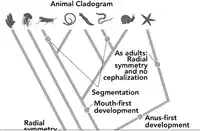
What information does this cladogram provide about the evolution of chordates? Select two correct answers.
A.
Chordate evolutionary trends include radial symmetry, no cephalization, and mouth-first development.
B.
Chordate evolutionary trends include bilateral symmetry, cephalization, and development of a backbone.
C.
All chordates are multicellular, autotrophic, and have prokaryotic cells with cell walls.
D.
All chordate phyla are most likely descended from a single ancestor.
Tags
NGSS.MS-LS4-2
NGSS.MS-LS4-1
5.
MULTIPLE CHOICE QUESTION
30 sec • 1 pt

Which of the nodes represents a common ancestor of arthropods and mollusks?
A.
Organs; 3 germ layers; bilateral symmetry; cephalization
B.
Radial symmetry
C.
As adults: radial symmetry and no cephalization
D.
Segmentation
Tags
NGSS.MS-LS4-2
6.
MULTIPLE CHOICE QUESTION
30 sec • 1 pt
Under the microscope you observe the development of an unfamiliar embryo. Over several days, you observe as a cell mass (blastula) forms first, followed by the development of an embryonic stage called a gastrula. Next, the embryo continues to develop into an elongated structure with a tube that runs from one end of the embryo to the other, with only one opening to the outside.
If the mouth of the embryo develops from this opening, could the embryo develop into a starfish? (Note: A starfish is an example of an echinoderm.)
A.
Yes, because echinoderms are invertebrates that develop a mouth first, followed by the anus.
B.
No, because echinoderm embryos develop the anus first, followed by the mouth opening.
C.
No, because echinoderms are radially symmetrical and do not go through the stages of blastula and gastrula.
D.
No, because echinoderms are radially symmetrical and their mouth also serves as the anus.
Tags
NGSS.MS-LS4-2
7.
MULTIPLE CHOICE QUESTION
30 sec • 1 pt
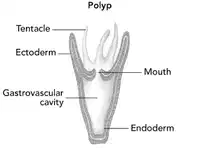
The diagram shows the cross section of a jellyfish polyp. Jellyfish, or jellies, are members of an invertebrate phylum called Cnidaria.
The presence of only two germ layers (ectoderm and endoderm) is evidence of which type of body symmetry in jellyfish?
A.
bilateral symmetry
B.
spherical symmetry
C.
radial symmetry
D.
asymmetry, or no symmetry
Access all questions and much more by creating a free account
Create resources
Host any resource
Get auto-graded reports

Continue with Google

Continue with Email

Continue with Classlink

Continue with Clever
or continue with

Microsoft
%20(1).png)
Apple

Others
Already have an account?


