
2.3 Plasma Membrane (Practice)
Authored by Addison Hilkert
Biology
10th Grade
NGSS covered


AI Actions
Add similar questions
Adjust reading levels
Convert to real-world scenario
Translate activity
More...
Content View
Student View
40 questions
Show all answers
1.
MULTIPLE CHOICE QUESTION
30 sec • 1 pt
The nonpolar tails of the phospholipids create a middle layer that allows other nonpolar substances to dissolve through.
The polar heads of the phospholipids repel nonpolar molecules, forcing them through the membrane.
The membrane is a solid, rigid structure that acts as a sieve for all small gas molecules.
2.
MULTIPLE CHOICE QUESTION
30 sec • 1 pt
In an experiment, a student models the cell membrane using a barrier. They find that large, polar molecules like glucose cannot cross the lipid portion of the bilayer. What is the most likely function of the channel proteins found in the actual cell membrane?
They provide a specific, hydrophilic pathway that allows large or polar molecules to bypass the hydrophobic lipid tails.
They act as enzymes that break down the lipid tails to let glucose pass through the holes.
They change the glucose into a nonpolar lipid so it can dissolve through the bilayer.
They serve as structural anchors that prevent the membrane from moving.
3.
MULTIPLE CHOICE QUESTION
30 sec • 1 pt
Scientists studying a species of fish in Lake Erie find that as water temperatures drop in the winter, the fish's cell membranes remain fluid and do not solidify. Which molecule is most likely responsible for maintaining this fluidity?
Cholesterol molecules embedded between the phospholipid tails.
Carbohydrate chains attached to the exterior of the membrane.
Transport proteins that move heat into the cell.
Peripheral proteins located only on the surface of the bilayer.
4.
MULTIPLE CHOICE QUESTION
30 sec • 1 pt
A diagram shows a cell membrane with various carbohydrate chains extending into the extracellular space. Based on the "Fluid Mosaic Model," what would happen if these carbohydrates were removed?
The cell would lose its ability to be recognized by other cells or the immune system.
The membrane would immediately dissolve because carbohydrates hold the lipids together.
The hydrophobic tails would become hydrophilic and attract water.
5.
MULTIPLE CHOICE QUESTION
30 sec • 1 pt
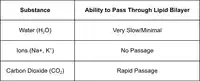
The hydrophobic core of the bilayer repels charged particles.
The ions are too small to be noticed by the membrane lipids.
The phospholipid heads are nonpolar and block the ions.
Ions can only move through the membrane if they are converted into gases.
6.
MULTIPLE CHOICE QUESTION
30 sec • 1 pt
Which of the following best describes the "hydrophilic" portion of a phospholipid found in a cell membrane?
The phosphate head, which is attracted to the water-based environments inside and outside the cell.
The fatty acid tails, which seek out water to maintain the membrane’s shape.
The cholesterol molecules, which bond with water to provide rigidity.
The protein channels, which push water away from the membrane.
7.
MULTIPLE CHOICE QUESTION
30 sec • 1 pt
A plant cell in an Ohio soybean field is exposed to a chemical that specifically binds to and blocks all peripheral proteins on the cell membrane's surface. What is the most likely immediate effect on the cell?
The cell may fail to receive or transmit signals from its environment.
The cell will lose its ability to create a bilayer.
The hydrophobic tails will flip to face the outside of the cell.
Access all questions and much more by creating a free account
Create resources
Host any resource
Get auto-graded reports

Continue with Google

Continue with Email

Continue with Classlink

Continue with Clever
or continue with

Microsoft
%20(1).png)
Apple

Others
Already have an account?


