
Exam2diagramsFINAL
Authored by Booo Wow
Science
University


AI Actions
Add similar questions
Adjust reading levels
Convert to real-world scenario
Translate activity
More...
Content View
Student View
21 questions
Show all answers
1.
MULTIPLE CHOICE QUESTION
30 sec • 1 pt
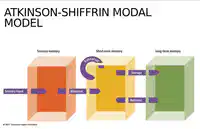
Using the Atkinson-Shiffrin Modal Model, explain how information moves from sensory memory to long-term memory, and identify the processes involved. Which of the following sequences best represents this flow?
Sensory input → Attention → Short-term memory → Rehearsal → Storage → Long-term memory
Sensory input → Storage → Long-term memory → Attention → Short-term memory
Sensory input → Retrieval → Short-term memory → Rehearsal → Long-term memory
Sensory input → Rehearsal → Storage → Sensory memory → Long-term memory
2.
MULTIPLE CHOICE QUESTION
30 sec • 1 pt
Strategically analyze the role of rehearsal in the Atkinson-Shiffrin Modal Model. Why is rehearsal important for transferring information from short-term memory to long-term memory?
Rehearsal increases the likelihood that information will be stored in long-term memory by repeated processing.
Rehearsal allows information to bypass short-term memory and go directly to long-term memory.
Rehearsal is only necessary for sensory memory, not for long-term memory.
Rehearsal decreases the chance of forgetting by keeping information in sensory memory.
3.
MULTIPLE CHOICE QUESTION
30 sec • 1 pt
Analyze the three levels of processing described by Craik & Lockhart and explain how each type of encoding might affect a student's ability to recall information during an exam. Use evidence from the diagram to support your reasoning.
Shallow processing leads to better recall because it focuses on the physical structure of information.
Intermediate processing is most effective for recall as it emphasizes the sound of words.
Deep processing enhances recall by focusing on the meaning of information, making it easier to retrieve during exams.
All levels of processing are equally effective for recall.
4.
MULTIPLE CHOICE QUESTION
30 sec • 1 pt
Given the examples of questions used to elicit encoding at different levels, design a study plan that incorporates all three types of encoding to maximize learning. Justify your approach based on the information in the diagram.
Focus only on structural encoding by rewriting notes in capital letters.
Use phonemic encoding by creating rhymes for all vocabulary words.
Combine structural, phonemic, and semantic encoding by using visual cues, rhymes, and meaningful sentences for each concept.
Rely solely on semantic encoding by making sentences for every term.
5.
MULTIPLE CHOICE QUESTION
30 sec • 1 pt
Evaluate the effectiveness of semantic encoding compared to structural and phonemic encoding in the context of long-term memory retention. Use reasoning and evidence from the diagram to support your answer.
Semantic encoding is less effective than structural encoding for long-term retention.
Phonemic encoding is equally effective as semantic encoding for long-term retention.
Semantic encoding is more effective for long-term retention because it emphasizes the meaning of information.
Structural encoding is the most effective for long-term retention.
6.
MULTIPLE CHOICE QUESTION
30 sec • 1 pt
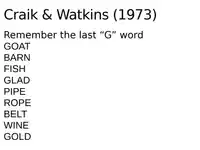
Based on the list of words provided, which word would you need to remember if instructed to recall the last word starting with the letter "G"? Explain your reasoning.
GOAT
GLAD
GOLD
BARN
7.
MULTIPLE CHOICE QUESTION
30 sec • 1 pt
Based on the Craik & Watkins (1973) study, analyze the relationship between rehearsal and short-term memory (STM) recall. Which interpretation best explains the actual data compared to the predicted outcomes?
The actual data shows that increased rehearsal always leads to higher STM recall, matching the predicted function of rehearsal.
The actual data suggests that rehearsal only improves STM recall when it is elaborative, not when it is non-elaborative.
The actual data indicates that rehearsal has no effect on STM recall, regardless of elaboration.
The actual data demonstrates that STM recall decreases as rehearsal increases.
Access all questions and much more by creating a free account
Create resources
Host any resource
Get auto-graded reports

Continue with Google

Continue with Email

Continue with Microsoft
or continue with

%20(1).png)
Apple

Others
Already have an account?

