
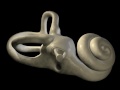
Exploring Auditory Transduction and the Inner Ear

Interactive Video
•
Biology
•
6th - 10th Grade
•
Practice Problem
•
Hard

Liam Anderson
FREE Resource
Read more
10 questions
Show all answers
1.
MULTIPLE CHOICE QUESTION
30 sec • 1 pt
What is the process called that converts sound waves into electrical impulses?
Gustatory Transduction
Olfactory Transduction
Visual Transduction
Auditory Transduction
2.
MULTIPLE CHOICE QUESTION
30 sec • 1 pt
Where does sound meet the tympanic membrane?
External auditory canal
Middle ear
Cochlea
Inner ear
3.
MULTIPLE CHOICE QUESTION
30 sec • 1 pt
What type of sound produces a slower rate of vibration?
Low amplitude
High amplitude
Low frequency
High frequency
4.
MULTIPLE CHOICE QUESTION
30 sec • 1 pt
Which bone is not part of the auditory ossicles?
Stapes
Malleus
Cochlea
Incus
5.
MULTIPLE CHOICE QUESTION
30 sec • 1 pt
What holds the auditory ossicles in place within the middle ear cavity?
Muscles
Ligaments
Nerves
Tendons
6.
MULTIPLE CHOICE QUESTION
30 sec • 1 pt
What fluid fills the bony labyrinth?
Blood
Cerebrospinal fluid
Perilymph
Endolymph
7.
MULTIPLE CHOICE QUESTION
30 sec • 1 pt
What is the name of the membrane that allows the stapes' movement to displace the perilymph?
Oval window
Round window
Basilar membrane
Reissner's membrane
Access all questions and much more by creating a free account
Create resources
Host any resource
Get auto-graded reports

Continue with Google

Continue with Email

Continue with Classlink

Continue with Clever
or continue with

Microsoft
%20(1).png)
Apple

Others
Already have an account?

