
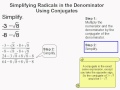
Simplifying Radicals in Denominators

Interactive Video
•
Mathematics
•
9th - 12th Grade
•
Practice Problem
•
Hard
+1
Standards-aligned

Olivia Brooks
FREE Resource
Standards-aligned
10 questions
Show all answers
1.
MULTIPLE CHOICE QUESTION
30 sec • 1 pt
What is a conjugate in the context of binomial expressions with radicals?
A completely different expression
A term with the same radical but a different coefficient
A term with the opposite sign and the same radical component
A term with the same sign and a different radical component
Tags
CCSS.HSN.CN.A.3
2.
MULTIPLE CHOICE QUESTION
30 sec • 1 pt
What is achieved by switching the sign in a conjugate?
Eliminating the radical from the denominator
Changing the value of the radical
None of the above
Creating a complex number
Tags
CCSS.HSN.CN.A.3
3.
MULTIPLE CHOICE QUESTION
30 sec • 1 pt
Why do we multiply by the conjugate in the process of simplifying radicals?
To eliminate the radical from the denominator
To increase the complexity of the expression
To change the sign of the radical
To balance the equation
Tags
CCSS.HSN.RN.A.2
4.
MULTIPLE CHOICE QUESTION
30 sec • 1 pt
What mathematical operation is primarily used in the process described in the video?
Addition
Multiplication
Subtraction
Division
Tags
CCSS.5.NBT.B.7
5.
MULTIPLE CHOICE QUESTION
30 sec • 1 pt
What happens to the square roots when we multiply by the conjugate?
They remain unchanged
They are multiplied by two
They cancel each other out
They are squared
6.
MULTIPLE CHOICE QUESTION
30 sec • 1 pt
What is the result of multiplying -3 by the square root of 8?
-24
24
3 root 8
-3 root 8
7.
MULTIPLE CHOICE QUESTION
30 sec • 1 pt
What is the simplified form of the square root of 8?
2 root 4
4 root 2
2 root 2
8 root 1
Access all questions and much more by creating a free account
Create resources
Host any resource
Get auto-graded reports

Continue with Google

Continue with Email

Continue with Classlink

Continue with Clever
or continue with

Microsoft
%20(1).png)
Apple

Others
Already have an account?


