
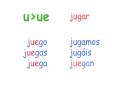
Understanding Stem-Changing Verbs in Spanish

Interactive Video
•
World Languages
•
7th - 10th Grade
•
Practice Problem
•
Medium

Mia Campbell
Used 41+ times
FREE Resource
Read more
10 questions
Show all answers
1.
MULTIPLE CHOICE QUESTION
30 sec • 1 pt
What is the main focus of stem-changing verbs in Spanish?
Adding prefixes to verbs
Altering the verb stem
Changing the verb endings
Removing vowels from verbs
2.
MULTIPLE CHOICE QUESTION
30 sec • 1 pt
How do you identify the stem of a verb in Spanish?
By finding the last vowel
By looking at the first syllable
By removing the AR, ER, or IR endings
By checking the verb's tense
3.
MULTIPLE CHOICE QUESTION
30 sec • 1 pt
Which of the following is an example of an e to IE stem change?
Pedir
Dormir
Empezar
Volver
4.
MULTIPLE CHOICE QUESTION
30 sec • 1 pt
In the e to IE stem change, which forms do not undergo a change?
First and second person singular
First and second person plural
Third person singular and plural
All forms change
5.
MULTIPLE CHOICE QUESTION
30 sec • 1 pt
Which verb undergoes an o to ue stem change?
Pedir
Servir
Volver
Empezar
6.
MULTIPLE CHOICE QUESTION
30 sec • 1 pt
What is unique about the verb 'vestirse' in terms of stem changes?
It changes in all forms
It is an irregular verb
It does not change at all
It is a reflexive verb
7.
MULTIPLE CHOICE QUESTION
30 sec • 1 pt
What shape can be drawn around the stem changes in stem-changing verbs?
Triangle
Circle
Square
Boot or shoe
Access all questions and much more by creating a free account
Create resources
Host any resource
Get auto-graded reports

Continue with Google

Continue with Email

Continue with Microsoft
or continue with

%20(1).png)
Apple

Others
By signing up, you agree to our Terms of Service & Privacy Policy
Already have an account?

