
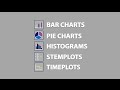
Data Visualization Techniques and Concepts

Interactive Video
•
Mathematics, Science
•
6th - 10th Grade
•
Practice Problem
•
Hard
Standards-aligned

Mia Campbell
FREE Resource
Standards-aligned
Read more
10 questions
Show all answers
1.
MULTIPLE CHOICE QUESTION
30 sec • 1 pt
Which type of chart is typically used to display categorical data?
Stem Plot
Time Plot
Pie Chart
Histogram
Tags
CCSS.6.SP.B.4
CCSS.HSS.ID.A.1
2.
MULTIPLE CHOICE QUESTION
30 sec • 1 pt
What does a histogram display on one of its axes?
Relative Size
Categories
Frequency or Count
Time
Tags
CCSS.6.SP.B.4
CCSS.HSS.ID.A.1
3.
MULTIPLE CHOICE QUESTION
30 sec • 1 pt
In a histogram, if a bar has a height of 8 for the interval 100-110, what does it signify?
8 people weigh less than 100 pounds
8 people weigh exactly 100 pounds
8 people weigh between 100 and 110 pounds
8 people weigh more than 110 pounds
4.
MULTIPLE CHOICE QUESTION
30 sec • 1 pt
What is the main difference between a frequency distribution and a relative frequency distribution?
Frequency distribution shows counts, relative frequency shows proportions
Frequency distribution shows proportions, relative frequency shows counts
Both show counts
Both show proportions
5.
MULTIPLE CHOICE QUESTION
30 sec • 1 pt
How do you convert a frequency distribution into a relative frequency distribution?
Subtract each frequency from the total number of data values
Multiply each frequency by 100
Divide each frequency by the total number of data values
Add all frequencies together
6.
MULTIPLE CHOICE QUESTION
30 sec • 1 pt
In a stem plot, what does the 'stem' represent?
The average of the data set
All digits except the last one
The last digit of a number
The total count of data points
7.
MULTIPLE CHOICE QUESTION
30 sec • 1 pt
What is a split stem plot used for?
To show categorical data
To separate data into more detailed intervals
To combine multiple data sets
To display time-based data
Access all questions and much more by creating a free account
Create resources
Host any resource
Get auto-graded reports

Continue with Google

Continue with Email

Continue with Microsoft
or continue with

%20(1).png)
Apple

Others
Already have an account?


