
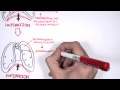
Respiratory System Mechanics

Interactive Video
•
Biology, Science
•
7th - 12th Grade
•
Practice Problem
•
Medium

Jackson Turner
Used 1+ times
FREE Resource
Read more
10 questions
Show all answers
1.
MULTIPLE CHOICE QUESTION
30 sec • 1 pt
What is the basic rule about the movement of gases?
Gases do not move based on pressure.
Gases move randomly.
Gases move from high to low pressure.
Gases move from low to high pressure.
2.
MULTIPLE CHOICE QUESTION
30 sec • 1 pt
Which of the following is NOT part of the respiratory tract?
Trachea
Larynx
Bronchi
Esophagus
3.
MULTIPLE CHOICE QUESTION
30 sec • 1 pt
What is the role of the diaphragm in respiration?
It increases lung pressure.
It decreases lung volume.
It contracts to increase lung volume.
It relaxes to increase lung volume.
4.
MULTIPLE CHOICE QUESTION
30 sec • 1 pt
What is the atmospheric pressure measured in mmHg?
780 mmHg
770 mmHg
750 mmHg
760 mmHg
5.
MULTIPLE CHOICE QUESTION
30 sec • 1 pt
How does the intrapulmonary pressure change during inspiration?
It increases to 762 mmHg.
It decreases to 759 mmHg.
It remains at 760 mmHg.
It increases to 761 mmHg.
6.
MULTIPLE CHOICE QUESTION
30 sec • 1 pt
What happens to the diaphragm during inspiration?
It moves up.
It moves down.
It stays in place.
It rotates.
7.
MULTIPLE CHOICE QUESTION
30 sec • 1 pt
During expiration, what happens to the intrapulmonary pressure?
It decreases to 758 mmHg.
It remains at 760 mmHg.
It increases to 761 mmHg.
It decreases to 759 mmHg.
Access all questions and much more by creating a free account
Create resources
Host any resource
Get auto-graded reports

Continue with Google

Continue with Email

Continue with Classlink

Continue with Clever
or continue with

Microsoft
%20(1).png)
Apple

Others
Already have an account?
Similar Resources on Wayground

11 questions
Weather Balloon Operations and Data Collection
Interactive video
•
7th - 12th Grade
11 questions
Supersonic Flight and the X-59
Interactive video
•
7th - 12th Grade
11 questions
Oxygen Production and Water Resources on the Moon
Interactive video
•
7th - 12th Grade
11 questions
Understanding Bicycle Mechanics
Interactive video
•
6th - 12th Grade
11 questions
Vine Robot Functionality and Applications
Interactive video
•
8th - 12th Grade
11 questions
Team Performance and Strategy Analysis
Interactive video
•
7th - 12th Grade
Popular Resources on Wayground
15 questions
Fractions on a Number Line

Quiz
•
3rd Grade
20 questions
Equivalent Fractions
Quiz
•
3rd Grade
25 questions
Multiplication Facts
Quiz
•
5th Grade
29 questions
Alg. 1 Section 5.1 Coordinate Plane
Quiz
•
9th Grade
22 questions
fractions
Quiz
•
3rd Grade
11 questions
FOREST Effective communication

Lesson
•
KG
20 questions
Main Idea and Details
Quiz
•
5th Grade
20 questions
Context Clues
Quiz
•
6th Grade
Discover more resources for Biology
22 questions
Human Body Systems Overview
Quiz
•
9th Grade
25 questions
photosynthesis and cellular respiration
Quiz
•
9th Grade
12 questions
Check Mitosis Vs. Meiosis
Quiz
•
9th Grade
15 questions
DNA Structure and Replication
Quiz
•
9th Grade
21 questions
Cell Cycle and mitosis
Quiz
•
9th - 10th Grade
18 questions
Enzymes and Their Functions Quiz
Quiz
•
9th Grade
20 questions
Food Chains and Food Webs
Quiz
•
7th - 12th Grade
20 questions
Natural Selection
Quiz
•
8th Grade