
Definite Integral Evaluation Quiz

Interactive Video
•
Mathematics
•
9th - 12th Grade
•
Practice Problem
•
Hard

Ethan Morris
FREE Resource
Read more
10 questions
Show all answers
1.
MULTIPLE CHOICE QUESTION
30 sec • 1 pt
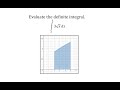
What is the interval of integration for the given function?
From 0 to 3
From 2 to 5
From 1 to 4
From 3 to 6
2.
MULTIPLE CHOICE QUESTION
30 sec • 1 pt
What is the integrand function in the problem?
f(x) = 3√x
f(x) = 2x
f(x) = x^3
f(x) = x^2
3.
MULTIPLE CHOICE QUESTION
30 sec • 1 pt
How is the square root of x expressed using a rational exponent?
x^1
x^2
x^1/2
x^3/2
4.
MULTIPLE CHOICE QUESTION
30 sec • 1 pt
What rule is used to find the antiderivative of the function?
Product Rule
Quotient Rule
Power Rule
Chain Rule
5.
MULTIPLE CHOICE QUESTION
30 sec • 1 pt
What is the simplified form of the antiderivative?
2x^3/2
x^3
3x^1/2
x^2
6.
MULTIPLE CHOICE QUESTION
30 sec • 1 pt
What is the exact value of the definite integral before approximation?
3(5^3/2 - 2^3/2)
4(5^3/2 - 2^3/2)
5(5^3/2 - 2^3/2)
2(5^3/2 - 2^3/2)
7.
MULTIPLE CHOICE QUESTION
30 sec • 1 pt
What is the approximate decimal value of the definite integral?
17.7038
18.7038
16.7038
15.7038
Access all questions and much more by creating a free account
Create resources
Host any resource
Get auto-graded reports

Continue with Google

Continue with Email

Continue with Microsoft
or continue with

%20(1).png)
Apple

Others
By signing up, you agree to our Terms of Service & Privacy Policy
Already have an account?

