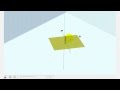
Understanding Parametric Equations and Planes

Interactive Video
•
Mathematics
•
9th - 12th Grade
•
Practice Problem
•
Hard
Standards-aligned

Lucas Foster
FREE Resource
Standards-aligned
Read more
10 questions
Show all answers
1.
MULTIPLE CHOICE QUESTION
30 sec • 1 pt
What is the main objective of the problem discussed in the video?
To calculate the area of a triangle formed by a line and a plane.
To find the distance between a point and a plane.
To determine the parametric equations of a line through a point and perpendicular to a plane.
To find the intersection of two planes.
2.
MULTIPLE CHOICE QUESTION
30 sec • 1 pt
What does the normal vector of a plane represent in relation to a line?
The normal vector is perpendicular to the line.
The normal vector is parallel to the line.
The normal vector is the midpoint of the line.
The normal vector is the endpoint of the line.
Tags
CCSS.4.G.A.1
CCSS.HSG.CO.A.1
3.
MULTIPLE CHOICE QUESTION
30 sec • 1 pt
How can the normal vector be used to find the direction vector of a line?
By dividing the normal vector by the line's point.
By subtracting the normal vector from the line's point.
By using the normal vector as the direction vector.
By adding the normal vector to the line's point.
Tags
CCSS.4.G.A.1
CCSS.HSG.CO.A.1
4.
MULTIPLE CHOICE QUESTION
30 sec • 1 pt
What is the significance of the graphical representation in the video?
It shows the intersection of two lines.
It illustrates the parallel relationship between the line and the normal vector.
It demonstrates the perpendicular relationship between two planes.
It highlights the distance between a point and a plane.
5.
MULTIPLE CHOICE QUESTION
30 sec • 1 pt
What are the components of the normal vector used in the video?
(3, 8, 1)
(1, 6, -5)
(3, 6, -1)
(8, 1, 3)
Tags
CCSS.HSA.CED.A.3
6.
MULTIPLE CHOICE QUESTION
30 sec • 1 pt
How is the x-component of the parametric equation for the line determined?
By dividing the x-component of the point by the normal vector's x-component.
By subtracting the x-component of the point from the normal vector's x-component.
By multiplying the x-component of the point by the normal vector's x-component.
By adding the x-component of the point to the normal vector's x-component multiplied by t.
Tags
CCSS.HSA.CED.A.3
7.
MULTIPLE CHOICE QUESTION
30 sec • 1 pt
What is the parametric equation for y(t) in the video?
y(t) = -5 - t
y(t) = 6 + 8t
y(t) = 3 + 6t
y(t) = 1 + 3t
Access all questions and much more by creating a free account
Create resources
Host any resource
Get auto-graded reports

Continue with Google

Continue with Email

Continue with Classlink

Continue with Clever
or continue with

Microsoft
%20(1).png)
Apple

Others
Already have an account?
Popular Resources on Wayground

7 questions
History of Valentine's Day
Interactive video
•
4th Grade
15 questions
Fractions on a Number Line

Quiz
•
3rd Grade
20 questions
Equivalent Fractions
Quiz
•
3rd Grade
25 questions
Multiplication Facts
Quiz
•
5th Grade
22 questions
fractions
Quiz
•
3rd Grade
15 questions
Valentine's Day Trivia
Quiz
•
3rd Grade
20 questions
Main Idea and Details
Quiz
•
5th Grade
20 questions
Context Clues
Quiz
•
6th Grade
Discover more resources for Mathematics
20 questions
Graphing Inequalities on a Number Line
Quiz
•
6th - 9th Grade
20 questions
Exponent Properties
Quiz
•
9th Grade
15 questions
Combine Like Terms and Distributive Property
Quiz
•
8th - 9th Grade
20 questions
Function or Not a Function
Quiz
•
8th - 9th Grade
10 questions
Factor Quadratic Expressions with Various Coefficients
Quiz
•
9th - 12th Grade
10 questions
Elijah McCoy: Innovations and Impact in Black History
Interactive video
•
6th - 10th Grade
10 questions
Evaluating Piecewise Functions Practice
Quiz
•
11th Grade
21 questions
Factoring Trinomials (a=1)
Quiz
•
9th Grade