
Population Growth and Differential Equations

Interactive Video
•
Mathematics, Science
•
9th - 12th Grade
•
Practice Problem
•
Hard

Ethan Morris
FREE Resource
Read more
10 questions
Show all answers
1.
MULTIPLE CHOICE QUESTION
30 sec • 1 pt
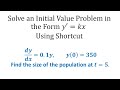
What does the differential equation dydt = 0.1 * y represent in the context of population growth?
A population with no change over time
A population growing at a rate proportional to its size
A population decreasing over time
A constant population size
2.
MULTIPLE CHOICE QUESTION
30 sec • 1 pt
What is the initial condition given in the problem?
y(0) = 100
y(0) = 500
y(0) = 0
y(0) = 350
3.
MULTIPLE CHOICE QUESTION
30 sec • 1 pt
What is the goal of the problem regarding the population size?
To find the population size at time t = 0
To find the initial population size
To find the population size at time t = 5
To find the population size at time t = 10
4.
MULTIPLE CHOICE QUESTION
30 sec • 1 pt
What is the shortcut method used for solving the differential equation?
Using the general solution y(t) = Ce^(Kt)
Separation of variables
Integration by parts
Differentiation
5.
MULTIPLE CHOICE QUESTION
30 sec • 1 pt
In the general solution y(t) = Ce^(Kt), what does the constant C represent?
The time at which the population is measured
The final population size
The initial population size
The growth rate
6.
MULTIPLE CHOICE QUESTION
30 sec • 1 pt
What is the value of the constant K in the given problem?
0.2
0.1
0.05
0.5
7.
MULTIPLE CHOICE QUESTION
30 sec • 1 pt
How is the particular solution for the population size expressed?
y(t) = 350 * e^(0.5 * t)
y(t) = 350 * e^(0.2 * t)
y(t) = 350 * e^(0.1 * t)
y(t) = 350 * e^(0.05 * t)
Access all questions and much more by creating a free account
Create resources
Host any resource
Get auto-graded reports

Continue with Google

Continue with Email

Continue with Microsoft
or continue with

%20(1).png)
Apple

Others
By signing up, you agree to our Terms of Service & Privacy Policy
Already have an account?

