
Antiderivatives and Definite Integrals

Interactive Video
•
Mathematics
•
10th - 12th Grade
•
Practice Problem
•
Hard

Mia Campbell
FREE Resource
Read more
10 questions
Show all answers
1.
MULTIPLE CHOICE QUESTION
30 sec • 1 pt
What does the Fundamental Theorem of Calculus allow us to do with a definite integral?
Find the derivative of a function
Calculate the limit of a sequence
Solve a differential equation
Determine the area under a curve
2.
MULTIPLE CHOICE QUESTION
30 sec • 1 pt
When applying the Fundamental Theorem of Calculus, why is the constant of integration not necessary?
It complicates the calculation
It cancels out when evaluating the definite integral
It is only needed for indefinite integrals
It is always zero
3.
MULTIPLE CHOICE QUESTION
30 sec • 1 pt
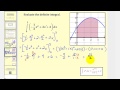
In the first example, what is the antiderivative of the function 2x + 1?
x^2 + 2x
2x^2 + x
2x^2 + 2x
x^2 + x
4.
MULTIPLE CHOICE QUESTION
30 sec • 1 pt
How is the area of the trapezoid verified in the first example?
Using the Fundamental Theorem of Calculus
Using the area formula for a trapezoid
By estimating with a graph
By calculating the derivative
5.
MULTIPLE CHOICE QUESTION
30 sec • 1 pt
What is the antiderivative of -1/2 x^2 + 2x + 2 in the second example?
-1/6 x^3 + 2x^2 + x
-1/6 x^3 + x^2 + 2x
-1/3 x^3 + 2x^2 + 2x
-1/3 x^3 + x^2 + 2x
6.
MULTIPLE CHOICE QUESTION
30 sec • 1 pt
What is the value of the definite integral in the second example?
10
21/2
21/3
10.5
7.
MULTIPLE CHOICE QUESTION
30 sec • 1 pt
In the final example, how is the square root of x expressed using rational exponents?
x^1/2
x^2
x^3/2
x^1/3
Access all questions and much more by creating a free account
Create resources
Host any resource
Get auto-graded reports

Continue with Google

Continue with Email

Continue with Classlink

Continue with Clever
or continue with

Microsoft
%20(1).png)
Apple

Others
Already have an account?

