
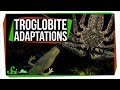
Cave-Dwelling Creatures and Their Adaptations

Interactive Video
•
Biology, Science
•
6th - 10th Grade
•
Practice Problem
•
Hard

Liam Anderson
FREE Resource
Read more
10 questions
Show all answers
1.
MULTIPLE CHOICE QUESTION
30 sec • 1 pt
What unique adaptation helps Mexican cave fish find food in the dark?
Increased number of taste buds
Ability to glow
Larger size
Enhanced eyesight
2.
MULTIPLE CHOICE QUESTION
30 sec • 1 pt
How do cave-dwelling whip spiders differ from their surface counterparts?
They have longer legs
They are more aggressive
They are less aggressive
They have better eyesight
3.
MULTIPLE CHOICE QUESTION
30 sec • 1 pt
What is the primary function of the glow worm's bioluminescence?
To navigate in the dark
To lure prey
To attract mates
To scare predators
4.
MULTIPLE CHOICE QUESTION
30 sec • 1 pt
What is the primary reason glow worms produce light?
To lure prey
To scare predators
To navigate in the dark
To attract mates
5.
MULTIPLE CHOICE QUESTION
30 sec • 1 pt
How do cave crickets sense sound in their environment?
Through their eyes
Using tympanal organs
By sensing ground vibrations
With their antennae
6.
MULTIPLE CHOICE QUESTION
30 sec • 1 pt
What adaptation allows cave crickets to locate mates?
Through their eyes
Using tympanal organs
With their antennae
By sensing ground vibrations
7.
MULTIPLE CHOICE QUESTION
30 sec • 1 pt
What is a unique feature of the olm salamander's sense of smell?
It has a special nose
Its olfactory epithelium is thicker
It uses its eyes to smell
It can only smell underwater
Access all questions and much more by creating a free account
Create resources
Host any resource
Get auto-graded reports

Continue with Google

Continue with Email

Continue with Classlink

Continue with Clever
or continue with

Microsoft
%20(1).png)
Apple

Others
Already have an account?

