
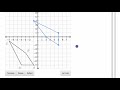
Mapping Shapes with Rigid Transformations

Interactive Video
•
Mathematics
•
6th - 8th Grade
•
Practice Problem
•
Easy
Standards-aligned

Jackson Turner
Used 1+ times
FREE Resource
Standards-aligned
Read more
10 questions
Show all answers
1.
MULTIPLE CHOICE QUESTION
30 sec • 1 pt
What are the three types of rigid transformations discussed in the video?
Translation, Scaling, Rotation
Translation, Rotation, Reflection
Translation, Scaling, Reflection
Reflection, Scaling, Rotation
Tags
CCSS.HSG.CO.A.2
2.
MULTIPLE CHOICE QUESTION
30 sec • 1 pt
In the first example, which point is initially overlapped using translation?
Point C
Point D
Point B
Point A
Tags
CCSS.8.G.A.3
CCSS.HSG.CO.A.5
3.
MULTIPLE CHOICE QUESTION
30 sec • 1 pt
After translating the quadrilateral in the first example, what transformation is used next?
Scaling
Reflection
Shearing
Rotation
Tags
CCSS.8.G.A.3
CCSS.HSG.CO.A.5
4.
MULTIPLE CHOICE QUESTION
30 sec • 1 pt
What is the purpose of using rotation in the first example?
To move the quadrilateral to a new position
To align the segments of the quadrilaterals
To change the size of the quadrilateral
To reflect the quadrilateral over a line
Tags
CCSS.8.G.A.3
CCSS.HSG.CO.A.5
5.
MULTIPLE CHOICE QUESTION
30 sec • 1 pt
In the second example, which points are initially overlapped using translation?
Points A and B
Points D and C
Points B and D
Points C and A
Tags
CCSS.8.G.A.3
CCSS.HSG.CO.A.5
6.
MULTIPLE CHOICE QUESTION
30 sec • 1 pt
What transformation is considered after translation in the second example?
Translation
Scaling
Rotation
Reflection
Tags
CCSS.8.G.A.3
CCSS.HSG.CO.A.5
7.
MULTIPLE CHOICE QUESTION
30 sec • 1 pt
Why is reflection chosen in the second example?
Because the quadrilateral needs to be rotated
Because the quadrilateral needs to be resized
Because the points are already aligned
Because overlapping points indicate a reflection
Tags
CCSS.8.G.A.3
CCSS.HSG.CO.A.5
Access all questions and much more by creating a free account
Create resources
Host any resource
Get auto-graded reports

Continue with Google

Continue with Email

Continue with Classlink

Continue with Clever
or continue with

Microsoft
%20(1).png)
Apple

Others
Already have an account?
Popular Resources on Wayground

15 questions
Fractions on a Number Line

Quiz
•
3rd Grade
20 questions
Equivalent Fractions
Quiz
•
3rd Grade
25 questions
Multiplication Facts
Quiz
•
5th Grade
29 questions
Alg. 1 Section 5.1 Coordinate Plane
Quiz
•
9th Grade
22 questions
fractions
Quiz
•
3rd Grade
11 questions
FOREST Effective communication

Lesson
•
KG
20 questions
Main Idea and Details
Quiz
•
5th Grade
20 questions
Context Clues
Quiz
•
6th Grade
Discover more resources for Mathematics
36 questions
6th Grade Math STAAR Review
Quiz
•
6th Grade
14 questions
Volume of rectangular prisms
Quiz
•
7th Grade
14 questions
finding slope from a graph
Quiz
•
8th Grade
20 questions
Graphing Inequalities on a Number Line
Quiz
•
6th - 9th Grade
23 questions
Solve and Graph Inequalities
Quiz
•
6th Grade
15 questions
Distributive Property & Review
Quiz
•
6th Grade
10 questions
Mean, Median, Mode, and Range
Quiz
•
7th Grade
17 questions
Area of a parallelogram
Quiz
•
6th Grade