
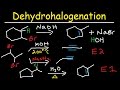
E2 and E1 Reaction Mechanisms

Interactive Video
•
Chemistry, Science
•
10th Grade - University
•
Practice Problem
•
Hard

Amelia Wright
FREE Resource
Read more
10 questions
Show all answers
1.
MULTIPLE CHOICE QUESTION
30 sec • 1 pt
What is the primary focus of dehydrohalogenation reactions discussed in the video?
Synthesis of ethers
Formation of alcohols
Conversion of alkyl halides into alkenes and alkynes
Production of ketones
2.
MULTIPLE CHOICE QUESTION
30 sec • 1 pt
Which base is typically used in the E2 mechanism to convert two-bromobutane into an alkene?
Sodium chloride
Lithium aluminum hydride
Sodium bicarbonate
Potassium hydroxide
3.
MULTIPLE CHOICE QUESTION
30 sec • 1 pt
What is the major product when using a strong base in the E2 reaction of two-bromobutane?
2-bromo-2-butene
Cis-2-butene
Trans-2-butene
1-butene
4.
MULTIPLE CHOICE QUESTION
30 sec • 1 pt
In the E2 reaction, what is the term for the product with the more substituted alkene?
Wurtz product
Hofmann product
Zaitsev product
Markovnikov product
5.
MULTIPLE CHOICE QUESTION
30 sec • 1 pt
What is the effect of using a bulky base like potassium tert-butoxide in an E2 reaction?
It increases the reaction rate
It favors the formation of the Zaitsev product
It prevents the reaction from occurring
It leads to the formation of the Hofmann product
6.
MULTIPLE CHOICE QUESTION
30 sec • 1 pt
What type of rearrangement can occur during an E1 reaction?
Proton shift
Hydride shift
Radical shift
Carbanion shift
7.
MULTIPLE CHOICE QUESTION
30 sec • 1 pt
Which solvent is used in the E1 reaction to favor elimination over substitution?
Acetone
Water
Ether
Methanol
Access all questions and much more by creating a free account
Create resources
Host any resource
Get auto-graded reports

Continue with Google

Continue with Email

Continue with Classlink

Continue with Clever
or continue with

Microsoft
%20(1).png)
Apple

Others
Already have an account?

