
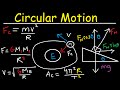
Centripetal Force and Motion Concepts

Interactive Video
•
Physics, Science
•
9th - 12th Grade
•
Practice Problem
•
Medium

Ethan Morris
Used 3+ times
FREE Resource
Read more
10 questions
Show all answers
1.
MULTIPLE CHOICE QUESTION
30 sec • 1 pt
What happens to an object when the force and velocity vectors are perpendicular?
The object moves in a circle.
The object speeds up.
The object stops moving.
The object slows down.
2.
MULTIPLE CHOICE QUESTION
30 sec • 1 pt
How does doubling the mass of an object affect the centripetal force required to keep it moving in a circle?
The centripetal force remains the same.
The centripetal force doubles.
The centripetal force quadruples.
The centripetal force is halved.
3.
MULTIPLE CHOICE QUESTION
30 sec • 1 pt
If the radius of a circle is tripled, what happens to the centripetal force required to maintain circular motion?
It triples.
It doubles.
It remains the same.
It is reduced to one-third.
4.
MULTIPLE CHOICE QUESTION
30 sec • 1 pt
What is the minimum speed required for a ball to maintain a circular path at the top of a vertical circle?
The speed must be zero.
The speed must be equal to the gravitational acceleration.
The speed must be less than the gravitational acceleration.
The speed must be greater than the gravitational acceleration.
5.
MULTIPLE CHOICE QUESTION
30 sec • 1 pt
In a banked curve with no friction, what provides the centripetal force necessary for a car to make the turn?
The weight of the car.
The gravitational force.
The normal force.
The frictional force.
6.
MULTIPLE CHOICE QUESTION
30 sec • 1 pt
What is the formula to calculate the angle at which a road should be banked to avoid friction during a turn?
theta = inverse cotangent of (v^2 / rg)
theta = inverse cosine of (v^2 / rg)
theta = inverse sine of (v^2 / rg)
theta = inverse tangent of (v^2 / rg)
7.
MULTIPLE CHOICE QUESTION
30 sec • 1 pt
How do you calculate the net acceleration of a car moving in a circle?
By dividing the tangential acceleration by the radial acceleration
By using the Pythagorean theorem on tangential and radial accelerations
By subtracting the radial acceleration from the tangential acceleration
By adding the tangential and radial accelerations
Access all questions and much more by creating a free account
Create resources
Host any resource
Get auto-graded reports

Continue with Google

Continue with Email

Continue with Microsoft
or continue with

%20(1).png)
Apple

Others
By signing up, you agree to our Terms of Service & Privacy Policy
Already have an account?

