
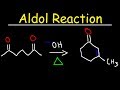
Aldol Condensation Mechanism Concepts

Interactive Video
•
Chemistry, Science
•
10th Grade - University
•
Practice Problem
•
Hard

Sophia Harris
FREE Resource
Read more
10 questions
Show all answers
1.
MULTIPLE CHOICE QUESTION
30 sec • 1 pt
What is formed when an aldehyde reacts with itself in the presence of a base?
A carboxylic acid
An ester
A ketone
A beta-hydroxy aldehyde
2.
MULTIPLE CHOICE QUESTION
30 sec • 1 pt
Which reaction is the reverse of the aldol addition reaction?
Esterification
Dehydration
Hydrolysis
Retroaldol reaction
3.
MULTIPLE CHOICE QUESTION
30 sec • 1 pt
What happens to the aldol addition product when it is heated?
It forms a carboxylic acid
It decomposes into carbon dioxide
It forms an alpha-beta unsaturated aldehyde
It remains unchanged
4.
MULTIPLE CHOICE QUESTION
30 sec • 1 pt
What is the key feature of the aldol condensation product?
No bond between the alpha and beta carbon
A single bond between the alpha and beta carbon
A triple bond between the alpha and beta carbon
A double bond between the alpha and beta carbon
5.
MULTIPLE CHOICE QUESTION
30 sec • 1 pt
In the aldol condensation mechanism, what role does the enolate ion play?
It acts as a solvent
It acts as a catalyst
It acts as an electrophile
It acts as a nucleophile
6.
MULTIPLE CHOICE QUESTION
30 sec • 1 pt
What is the first step in the aldol reaction using acetone?
Formation of a carbon-oxygen bond
Removal of the alpha hydrogen
Formation of a carbon-carbon bond
Addition of water
7.
MULTIPLE CHOICE QUESTION
30 sec • 1 pt
What type of ring is formed in an intramolecular aldol reaction with a 1,5-diketone?
Six-membered ring
Four-membered ring
Five-membered ring
Seven-membered ring
Access all questions and much more by creating a free account
Create resources
Host any resource
Get auto-graded reports

Continue with Google

Continue with Email

Continue with Microsoft
or continue with

%20(1).png)
Apple

Others
Already have an account?

