
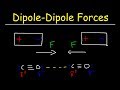
Understanding Dipole-Dipole Forces

Interactive Video
•
Physics, Chemistry, Science
•
9th - 12th Grade
•
Practice Problem
•
Easy

Amelia Wright
Used 3+ times
FREE Resource
Read more
10 questions
Show all answers
1.
MULTIPLE CHOICE QUESTION
30 sec • 1 pt
What happens when two like charges are placed next to each other?
They form a bond.
They remain stationary.
They repel each other.
They attract each other.
2.
MULTIPLE CHOICE QUESTION
30 sec • 1 pt
How is a dipole different from an ion?
A dipole has a net charge, while an ion is neutral.
A dipole is a single particle, while an ion is a molecule.
A dipole is neutral with separated charges, while an ion has a net charge.
A dipole is always positive, while an ion is always negative.
3.
MULTIPLE CHOICE QUESTION
30 sec • 1 pt
What causes the partial charges in a polar molecule like carbon monoxide?
The presence of ions.
The difference in electronegativity between atoms.
The temperature of the environment.
The molecule's shape.
4.
MULTIPLE CHOICE QUESTION
30 sec • 1 pt
What is a dipole-dipole force?
A force that repels like charges.
A force within a molecule.
A force between two ions.
A force between two polar molecules.
5.
MULTIPLE CHOICE QUESTION
30 sec • 1 pt
In the context of dipole-dipole interactions, what is the role of partial charges?
They make molecules neutral.
They create an attraction between molecules.
They have no effect on molecular interactions.
They cause molecules to repel each other.
6.
MULTIPLE CHOICE QUESTION
30 sec • 1 pt
Which type of force is generally stronger?
Intramolecular forces
Intermolecular forces
Electrostatic forces
Dipole-dipole forces
7.
MULTIPLE CHOICE QUESTION
30 sec • 1 pt
What is the main difference between intramolecular and intermolecular forces?
Intramolecular forces occur within a molecule, while intermolecular forces occur between molecules.
Intramolecular forces occur between molecules, while intermolecular forces occur within a molecule.
Intramolecular forces are weaker than intermolecular forces.
Intramolecular forces are only found in gases.
Access all questions and much more by creating a free account
Create resources
Host any resource
Get auto-graded reports

Continue with Google

Continue with Email

Continue with Microsoft
or continue with

%20(1).png)
Apple

Others
By signing up, you agree to our Terms of Service & Privacy Policy
Already have an account?


