
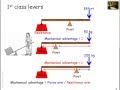
Levers in the Human Body and Their Mechanical Advantages

Interactive Video
•
Physics, Biology, Science
•
9th - 10th Grade
•
Practice Problem
•
Hard

Patricia Brown
FREE Resource
Read more
10 questions
Show all answers
1.
MULTIPLE CHOICE QUESTION
30 sec • 1 pt
What is the mechanical advantage of a lever determined by?
The weight of the lever
The length of the lever
The material of the lever
The distance between the forces and the fulcrum
2.
MULTIPLE CHOICE QUESTION
30 sec • 1 pt
Which class of lever changes the direction of the effort force?
Fourth-class lever
Third-class lever
Second-class lever
First-class lever
3.
MULTIPLE CHOICE QUESTION
30 sec • 1 pt
In a first-class lever, where is the fulcrum located?
At the end of the lever
Closer to the resistance
Closer to the effort
Between the effort and resistance
4.
MULTIPLE CHOICE QUESTION
30 sec • 1 pt
What is a common example of a second-class lever in the human body?
Biceps flexing the forearm
Extension of the head
Flexion of the knee
Plantar flexion of the foot
5.
MULTIPLE CHOICE QUESTION
30 sec • 1 pt
What is sacrificed in a second-class lever to gain force?
Precision
Weight
Range of motion
Speed
6.
MULTIPLE CHOICE QUESTION
30 sec • 1 pt
In a third-class lever, where is the effort located?
Between the fulcrum and resistance
At the end of the lever
Closer to the fulcrum
Closer to the resistance
7.
MULTIPLE CHOICE QUESTION
30 sec • 1 pt
Which class of lever is most common in the human body?
First-class lever
Fourth-class lever
Second-class lever
Third-class lever
Access all questions and much more by creating a free account
Create resources
Host any resource
Get auto-graded reports

Continue with Google

Continue with Email

Continue with Microsoft
or continue with

%20(1).png)
Apple

Others
By signing up, you agree to our Terms of Service & Privacy Policy
Already have an account?

