
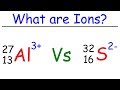
Ions Versus Atoms: Understanding Charge and Electron Count

Interactive Video
•
Chemistry, Science, Physics
•
9th - 10th Grade
•
Practice Problem
•
Hard

Patricia Brown
FREE Resource
Read more
10 questions
Show all answers
1.
MULTIPLE CHOICE QUESTION
30 sec • 1 pt
What is the main difference between an ion and an atom?
Ions are always larger than atoms.
Ions have a different number of protons compared to atoms.
Ions have an electrical charge, while atoms are neutral.
Ions have a different number of neutrons compared to atoms.
2.
MULTIPLE CHOICE QUESTION
30 sec • 1 pt
How do you calculate the number of electrons in an ion?
Subtract the charge from the atomic number.
Divide the atomic number by the charge.
Add the atomic number and the charge.
Multiply the atomic number by the charge.
3.
MULTIPLE CHOICE QUESTION
30 sec • 1 pt
Why is an atom electrically neutral?
Because it has no protons.
Because the number of protons equals the number of electrons.
Because it has more electrons than protons.
Because it has more protons than electrons.
4.
MULTIPLE CHOICE QUESTION
30 sec • 1 pt
In the example of sulfur, what is the net charge of the ion if it has 16 protons and 18 electrons?
+1
-1
-2
+2
5.
MULTIPLE CHOICE QUESTION
30 sec • 1 pt
What is the atomic number of sulfur?
17
16
15
14
6.
MULTIPLE CHOICE QUESTION
30 sec • 1 pt
How do you determine the atomic symbol of an ion?
By using the atomic number and the charge.
By using the number of neutrons only.
By using the charge only.
By using the mass number only.
7.
MULTIPLE CHOICE QUESTION
30 sec • 1 pt
What element has an atomic number of 15?
Nitrogen
Phosphorus
Oxygen
Sulfur
Access all questions and much more by creating a free account
Create resources
Host any resource
Get auto-graded reports

Continue with Google

Continue with Email

Continue with Classlink

Continue with Clever
or continue with

Microsoft
%20(1).png)
Apple

Others
Already have an account?


