
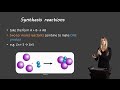
Chemical Reactions and Balancing

Interactive Video
•
Chemistry, Science, Biology
•
9th - 10th Grade
•
Practice Problem
•
Hard

Patricia Brown
FREE Resource
Read more
10 questions
Show all answers
1.
MULTIPLE CHOICE QUESTION
30 sec • 1 pt
What is the primary goal of a synthesis reaction?
To change the state of a substance
To combine multiple reactants into a single product
To break down a compound into simpler substances
To increase the temperature of a reaction
2.
MULTIPLE CHOICE QUESTION
30 sec • 1 pt
In a synthesis reaction, what should you look for to identify it?
Multiple reactants on the reactant side
A single product on the product side
Multiple products on the product side
A single reactant on the reactant side
3.
MULTIPLE CHOICE QUESTION
30 sec • 1 pt
Which of the following is a key characteristic of a decomposition reaction?
It requires a catalyst to proceed
It involves multiple products forming a single reactant
It involves a single reactant breaking into multiple products
It always produces a gas
4.
MULTIPLE CHOICE QUESTION
30 sec • 1 pt
What is the opposite of a synthesis reaction?
A combustion reaction
A decomposition reaction
A displacement reaction
A neutralization reaction
5.
MULTIPLE CHOICE QUESTION
30 sec • 1 pt
Which elements are typically diatomic in nature?
Transition metals
Halogens, oxygen, nitrogen, and hydrogen
Alkali metals
Noble gases
6.
MULTIPLE CHOICE QUESTION
30 sec • 1 pt
What rule is used to balance charges in ionic compounds?
The conservation of mass rule
The zero sum rule
The periodic table rule
The Avogadro's number rule
7.
MULTIPLE CHOICE QUESTION
30 sec • 1 pt
In the example of balancing a decomposition reaction, what was added to balance the oxygen?
A coefficient of 1
A coefficient of 4
A coefficient of 2
A coefficient of 3
Access all questions and much more by creating a free account
Create resources
Host any resource
Get auto-graded reports

Continue with Google

Continue with Email

Continue with Classlink

Continue with Clever
or continue with

Microsoft
%20(1).png)
Apple

Others
Already have an account?

