
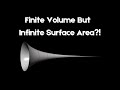
Gabriel's Horn: Volume and Surface Area

Interactive Video
•
Mathematics, Physics, Science
•
11th - 12th Grade
•
Practice Problem
•
Hard

Patricia Brown
FREE Resource
Read more
10 questions
Show all answers
1.
MULTIPLE CHOICE QUESTION
30 sec • 1 pt
What is the paradoxical nature of Gabriel's Horn?
It has infinite volume but finite surface area.
It has both infinite volume and surface area.
It has finite volume but infinite surface area.
It has both finite volume and surface area.
2.
MULTIPLE CHOICE QUESTION
30 sec • 1 pt
Which function is used to represent Gabriel's Horn?
f(x) = 1/x
f(x) = x^2
f(x) = x^3
f(x) = 1/x^2
3.
MULTIPLE CHOICE QUESTION
30 sec • 1 pt
How is Gabriel's Horn formed mathematically?
By rotating a line around the y-axis.
By rotating a parabola around the x-axis.
By rotating the region under the curve f(x) = 1/x around the x-axis.
By rotating a circle around the x-axis.
4.
MULTIPLE CHOICE QUESTION
30 sec • 1 pt
What is the volume of Gabriel's Horn?
Infinity
2 Pi
Zero
Pi
5.
MULTIPLE CHOICE QUESTION
30 sec • 1 pt
Which mathematical rule is used to find the volume of Gabriel's Horn?
Chain Rule
Product Rule
Quotient Rule
Reverse Power Rule
6.
MULTIPLE CHOICE QUESTION
30 sec • 1 pt
What is the result of the surface area integral for Gabriel's Horn?
Zero
Pi
Infinity
2 Pi
7.
MULTIPLE CHOICE QUESTION
30 sec • 1 pt
Why does the surface area of Gabriel's Horn become infinite?
Because the integral of 1/x diverges.
Because the integral of x^2 converges.
Because the integral of 1/x^2 converges.
Because the integral of x diverges.
Access all questions and much more by creating a free account
Create resources
Host any resource
Get auto-graded reports

Continue with Google

Continue with Email

Continue with Classlink

Continue with Clever
or continue with

Microsoft
%20(1).png)
Apple

Others
Already have an account?

