
Energy Transfer and Trophic Levels

Interactive Video
•
Biology, Science, Physics
•
9th - 10th Grade
•
Practice Problem
•
Hard

Patricia Brown
FREE Resource
Read more
10 questions
Show all answers
1.
MULTIPLE CHOICE QUESTION
30 sec • 1 pt
What is the general rule for energy transfer efficiency between trophic levels?
20% efficient
50% efficient
10% efficient
5% efficient
2.
MULTIPLE CHOICE QUESTION
30 sec • 1 pt
If 1000 joules of energy is available at the primary producer level, how much energy is typically available to the primary consumer?
100 joules
10 joules
500 joules
900 joules
3.
MULTIPLE CHOICE QUESTION
30 sec • 1 pt
How much energy is lost to cellular respiration when a caterpillar consumes 2000 joules?
33 joules
100 joules
200 joules
67 joules
4.
MULTIPLE CHOICE QUESTION
30 sec • 1 pt
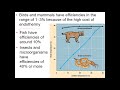
What is the efficiency range for birds and mammals in energy transfer?
1-3%
10-20%
30-40%
50-60%
5.
MULTIPLE CHOICE QUESTION
30 sec • 1 pt
Which type of organism has about 40% efficiency in energy transfer?
Birds
Mammals
Insects
Fish
6.
MULTIPLE CHOICE QUESTION
30 sec • 1 pt
What does an ecological pyramid illustrate?
The speed of energy transfer
The biomass at each trophic level
The number of organisms at each trophic level
The energy efficiency at each trophic level
7.
MULTIPLE CHOICE QUESTION
30 sec • 1 pt
What is a characteristic of inverted biomass pyramids?
Producers are consumed quickly
Consumers have more biomass than producers
Producers have a slow turnover rate
Energy is not lost as heat
Access all questions and much more by creating a free account
Create resources
Host any resource
Get auto-graded reports

Continue with Google

Continue with Email

Continue with Classlink

Continue with Clever
or continue with

Microsoft
%20(1).png)
Apple

Others
Already have an account?

