
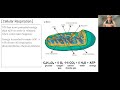
Cellular Respiration and ATP Production

Interactive Video
•
Biology, Science, Chemistry
•
9th - 10th Grade
•
Practice Problem
•
Hard

Patricia Brown
FREE Resource
Read more
10 questions
Show all answers
1.
MULTIPLE CHOICE QUESTION
30 sec • 1 pt
What is the primary role of ATP in cellular processes?
To act as a structural component of cells
To provide energy for cellular activities
To transport oxygen in the bloodstream
To store genetic information
2.
MULTIPLE CHOICE QUESTION
30 sec • 1 pt
Which components make up an ATP molecule?
Adenine, ribose, and three phosphate groups
Thymine, deoxyribose, and one phosphate group
Guanine, deoxyribose, and two phosphate groups
Cytosine, ribose, and four phosphate groups
3.
MULTIPLE CHOICE QUESTION
30 sec • 1 pt
What happens when ATP is converted to ADP?
Energy is absorbed
Energy is released
No energy change occurs
Energy is stored
4.
MULTIPLE CHOICE QUESTION
30 sec • 1 pt
How do mitochondria contribute to ATP production?
By storing ATP molecules
By creating a concentration gradient of hydrogen ions
By converting ADP directly into glucose
By breaking down ATP into ADP
5.
MULTIPLE CHOICE QUESTION
30 sec • 1 pt
What is the main difference between aerobic and anaerobic respiration?
Anaerobic respiration produces more ATP
Anaerobic respiration occurs in mitochondria
Aerobic respiration requires oxygen
Aerobic respiration occurs without oxygen
6.
MULTIPLE CHOICE QUESTION
30 sec • 1 pt
What byproduct is produced by yeast during anaerobic respiration?
Ethanol
Lactic acid
Glucose
Oxygen
7.
MULTIPLE CHOICE QUESTION
30 sec • 1 pt
In humans, what is the byproduct of anaerobic respiration?
Lactic acid
Carbon dioxide
Ethanol
Water
Access all questions and much more by creating a free account
Create resources
Host any resource
Get auto-graded reports

Continue with Google

Continue with Email

Continue with Microsoft
or continue with

%20(1).png)
Apple

Others
By signing up, you agree to our Terms of Service & Privacy Policy
Already have an account?

