
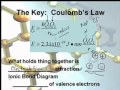
Chemical Bonds and Electrostatic Attraction

Interactive Video
•
Chemistry, Science, Physics
•
9th - 10th Grade
•
Practice Problem
•
Hard

Patricia Brown
FREE Resource
Read more
10 questions
Show all answers
1.
MULTIPLE CHOICE QUESTION
30 sec • 1 pt
What humorous activity does Mr. Sams engage in at the beginning of the video?
Dancing with a broom
Sticking styrofoam balls onto his face
Juggling test tubes
Singing a chemistry song
2.
MULTIPLE CHOICE QUESTION
30 sec • 1 pt
Which of the following is NOT a type of chemical bond discussed in the video?
Ionic bond
Covalent bond
Hydrogen bond
Metallic bond
3.
MULTIPLE CHOICE QUESTION
30 sec • 1 pt
In an ionic bond, what happens to the electrons?
They remain stationary
They are lost to the environment
They are transferred from one atom to another
They are shared equally between atoms
4.
MULTIPLE CHOICE QUESTION
30 sec • 1 pt
What happens to the charge of an atom when it loses an electron in an ionic bond?
It becomes negatively charged
It becomes positively charged
It remains neutral
It becomes unstable
5.
MULTIPLE CHOICE QUESTION
30 sec • 1 pt
What is the main force that holds atoms together in a bond?
Nuclear force
Magnetic attraction
Electrostatic attraction
Gravitational pull
6.
MULTIPLE CHOICE QUESTION
30 sec • 1 pt
Why do opposite charges attract each other?
Because of electrostatic attraction
Because they have similar properties
Due to the presence of magnetic fields
Due to gravitational forces
7.
MULTIPLE CHOICE QUESTION
30 sec • 1 pt
What analogy is used to explain the concept of electrostatic attraction?
Magnets and iron filings
Tape and static electricity
Glue and paper
Velcro and fabric
Access all questions and much more by creating a free account
Create resources
Host any resource
Get auto-graded reports

Continue with Google

Continue with Email

Continue with Classlink

Continue with Clever
or continue with

Microsoft
%20(1).png)
Apple

Others
Already have an account?

