
- Resource Library
- Math
- Probability And Statistics
- Relative Frequency
- Conditional And Relative Frequency Concepts
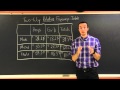
Conditional and Relative Frequency Concepts

Interactive Video
•
Mathematics
•
9th - 10th Grade
•
Practice Problem
•
Hard

Patricia Brown
FREE Resource
Read more
10 questions
Show all answers
1.
MULTIPLE CHOICE QUESTION
30 sec • 1 pt
What is the purpose of using a relative frequency table in the context of the video?
To list all the raw data collected from the experiment
To determine the fastest way to solve a problem
To convert raw data into percentages for easier analysis
To calculate the average score of the class
2.
MULTIPLE CHOICE QUESTION
30 sec • 1 pt
Which of the following best describes joint relative frequency?
Percentages on the outside of the table
Percentages on the inside of the table
The total number of participants
The average score of participants
3.
MULTIPLE CHOICE QUESTION
30 sec • 1 pt
How can you remember what joint relative frequency represents?
By thinking of the margins of a paper
By considering the total number of participants
By calculating the average score
By associating it with being in jail or 'the joint'
4.
MULTIPLE CHOICE QUESTION
30 sec • 1 pt
What does marginal relative frequency refer to?
Percentages on the inside of the table
The total number of participants
Percentages on the outside of the table
The average score of participants
5.
MULTIPLE CHOICE QUESTION
30 sec • 1 pt
In the context of the video, what is an example of a marginal relative frequency?
The percentage of missed baskets by boys
The percentage of baskets made by all participants
The percentage of girls who played the game
The percentage of boys who made a basket
6.
MULTIPLE CHOICE QUESTION
30 sec • 1 pt
What is conditional relative frequency?
The probability of an event without any conditions
The probability of an event given a specific condition
The total number of events
The average probability of all events
7.
MULTIPLE CHOICE QUESTION
30 sec • 1 pt
How do you calculate the conditional probability of a girl missing a basket?
Divide the total number of girls by the number of girls who missed
Divide the total number of participants by the number of girls who missed
Divide the number of girls who missed by the total number of girls
Divide the number of girls who missed by the total number of participants
Access all questions and much more by creating a free account
Create resources
Host any resource
Get auto-graded reports

Continue with Google

Continue with Email

Continue with Microsoft
or continue with

%20(1).png)
Apple

Others
By signing up, you agree to our Terms of Service & Privacy Policy
Already have an account?

