
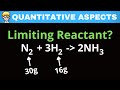
Limiting Reagents and Molar Masses

Interactive Video
•
Chemistry, Science, Mathematics
•
9th - 12th Grade
•
Practice Problem
•
Hard

Patricia Brown
FREE Resource
Read more
10 questions
Show all answers
1.
MULTIPLE CHOICE QUESTION
30 sec • 1 pt
What is the first step in determining the limiting reagent in a chemical reaction?
Determine the temperature of the reaction.
Calculate the volume of the reactants.
Convert the masses of reactants to moles.
Identify the products of the reaction.
2.
MULTIPLE CHOICE QUESTION
30 sec • 1 pt
In the reaction between nitrogen and hydrogen to form ammonia, what is the mole ratio of nitrogen to hydrogen?
1:3
2:3
1:2
1:1
3.
MULTIPLE CHOICE QUESTION
30 sec • 1 pt
Why is it important to use the limiting reagent when calculating the mass of a product?
It ensures all reactants are used up.
It determines the maximum amount of product formed.
It increases the reaction rate.
It balances the chemical equation.
4.
MULTIPLE CHOICE QUESTION
30 sec • 1 pt
If you have 1.07 moles of nitrogen and 8 moles of hydrogen, which is the limiting reagent?
Neither is limiting
Both are limiting
Nitrogen
Hydrogen
5.
MULTIPLE CHOICE QUESTION
30 sec • 1 pt
In a reaction between methane and oxygen, what is the mole ratio of methane to oxygen?
1:2
1:1
2:1
2:2
6.
MULTIPLE CHOICE QUESTION
30 sec • 1 pt
What is the molar mass of CO2 used in the calculations?
28 g/mol
44 g/mol
32 g/mol
18 g/mol
7.
MULTIPLE CHOICE QUESTION
30 sec • 1 pt
In the reaction involving sulfuric acid and lithium hydroxide, what is the mole ratio of H2SO4 to LiOH?
1:1
1:2
2:1
2:2
Access all questions and much more by creating a free account
Create resources
Host any resource
Get auto-graded reports

Continue with Google

Continue with Email

Continue with Classlink

Continue with Clever
or continue with

Microsoft
%20(1).png)
Apple

Others
Already have an account?

