
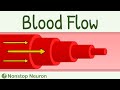
Turbulent Blood Flow Concepts

Interactive Video
•
Biology, Science, Physics
•
9th - 10th Grade
•
Practice Problem
•
Hard

Patricia Brown
FREE Resource
Read more
10 questions
Show all answers
1.
MULTIPLE CHOICE QUESTION
30 sec • 1 pt
What is the typical blood flow rate through the entire systemic circulation in a resting adult?
3000 ml/min
7000 ml/min
1000 ml/min
5000 ml/min
2.
MULTIPLE CHOICE QUESTION
30 sec • 1 pt
In laminar blood flow, how does the velocity of blood change from the vessel wall to the center?
It decreases
It remains constant
It increases
It fluctuates
3.
MULTIPLE CHOICE QUESTION
30 sec • 1 pt
Which condition is NOT likely to cause turbulent blood flow?
Sharp turn in the vessel
Smooth vessel surface
Obstruction in a vessel
High blood flow
4.
MULTIPLE CHOICE QUESTION
30 sec • 1 pt
What is the Reynolds number used for in the context of blood flow?
To determine blood viscosity
To calculate cardiac output
To predict laminar or turbulent flow
To measure blood pressure
5.
MULTIPLE CHOICE QUESTION
30 sec • 1 pt
Which factor does NOT increase the Reynolds number?
Higher blood velocity
Larger vessel diameter
Higher blood density
Increased blood viscosity
6.
MULTIPLE CHOICE QUESTION
30 sec • 1 pt
In which type of vessel is blood flow almost always laminar?
Aorta
Pulmonary artery
Small vessels
Large arteries
7.
MULTIPLE CHOICE QUESTION
30 sec • 1 pt
What sound is associated with turbulent blood flow during blood pressure measurement?
Korotkoff sounds
Bruit
Thrill
Whispering
Access all questions and much more by creating a free account
Create resources
Host any resource
Get auto-graded reports

Continue with Google

Continue with Email

Continue with Classlink

Continue with Clever
or continue with

Microsoft
%20(1).png)
Apple

Others
Already have an account?

