
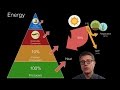
Energy Transfer and Ecosystem Dynamics

Interactive Video
•
Biology, Science, Chemistry
•
9th - 10th Grade
•
Practice Problem
•
Hard

Patricia Brown
FREE Resource
Read more
10 questions
Show all answers
1.
MULTIPLE CHOICE QUESTION
30 sec • 1 pt
What is the primary source of energy for producers on Earth?
The Moon
The Sun
The Wind
The Ocean
2.
MULTIPLE CHOICE QUESTION
30 sec • 1 pt
Which process allows plants to convert sunlight into usable energy?
Chemosynthesis
Photosynthesis
Respiration
Fermentation
3.
MULTIPLE CHOICE QUESTION
30 sec • 1 pt
What is the main difference between gross primary productivity and net primary productivity?
Net includes respiration, gross does not
Net is always higher than gross
Gross includes respiration, net does not
Gross is always higher than net
4.
MULTIPLE CHOICE QUESTION
30 sec • 1 pt
What are the two main products of photosynthesis?
Carbon dioxide and water
Oxygen and glucose
Nitrogen and oxygen
Glucose and nitrogen
5.
MULTIPLE CHOICE QUESTION
30 sec • 1 pt
How does cellular respiration relate to photosynthesis?
It uses the same reactants
It is the reverse of photosynthesis
It produces the same products
It occurs only in plants
6.
MULTIPLE CHOICE QUESTION
30 sec • 1 pt
Which biome is known for having the highest productivity?
Savanna
Desert
Tundra
Tropical rainforest
7.
MULTIPLE CHOICE QUESTION
30 sec • 1 pt
What percentage of energy typically transfers from one trophic level to the next?
10%
1%
100%
50%
Access all questions and much more by creating a free account
Create resources
Host any resource
Get auto-graded reports

Continue with Google

Continue with Email

Continue with Classlink

Continue with Clever
or continue with

Microsoft
%20(1).png)
Apple

Others
Already have an account?
Popular Resources on Wayground

15 questions
Fractions on a Number Line

Quiz
•
3rd Grade
20 questions
Equivalent Fractions
Quiz
•
3rd Grade
25 questions
Multiplication Facts
Quiz
•
5th Grade
29 questions
Alg. 1 Section 5.1 Coordinate Plane
Quiz
•
9th Grade
22 questions
fractions
Quiz
•
3rd Grade
11 questions
FOREST Effective communication

Lesson
•
KG
20 questions
Main Idea and Details
Quiz
•
5th Grade
20 questions
Context Clues
Quiz
•
6th Grade
Discover more resources for Biology
22 questions
Human Body Systems Overview
Quiz
•
9th Grade
25 questions
photosynthesis and cellular respiration
Quiz
•
9th Grade
12 questions
Check Mitosis Vs. Meiosis
Quiz
•
9th Grade
15 questions
DNA Structure and Replication
Quiz
•
9th Grade
21 questions
Cell Cycle and mitosis
Quiz
•
9th - 10th Grade
18 questions
Enzymes and Their Functions Quiz
Quiz
•
9th Grade
20 questions
Food Chains and Food Webs
Quiz
•
7th - 12th Grade
10 questions
Exploring Food Webs and Energy Pyramids
Interactive video
•
6th - 10th Grade