
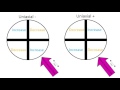
Uniaxial Minerals Observation Techniques

Interactive Video
•
Other
•
11th - 12th Grade
•
Practice Problem
•
Hard

Patricia Brown
FREE Resource
Read more
10 questions
Show all answers
1.
MULTIPLE CHOICE QUESTION
30 sec • 1 pt
What is the primary goal when studying uniaxial minerals?
To identify their optic sign
To determine their chemical composition
To assess their hardness
To measure their density
2.
MULTIPLE CHOICE QUESTION
30 sec • 1 pt
What is the first step in preparing the microscope for observing uniaxial minerals?
Insert the Bertrand lens
Switch to the highest magnification
Find and center your grain
Insert the accessory plate
3.
MULTIPLE CHOICE QUESTION
30 sec • 1 pt
What is the shape of the uniaxial optic axis interference figure?
A triangle
A cross
A square
A circle
4.
MULTIPLE CHOICE QUESTION
30 sec • 1 pt
What happens to the interference colors when the accessory plate is inserted?
They disappear
They remain unchanged
They change in specific quadrants
They become more vibrant
5.
MULTIPLE CHOICE QUESTION
30 sec • 1 pt
How do you determine if a mineral is uniaxial positive or negative?
By assessing its hardness
By measuring its density
By checking its chemical composition
By observing the change in interference colors
6.
MULTIPLE CHOICE QUESTION
30 sec • 1 pt
What is the role of isogyres in determining the optic sign?
They indicate the mineral's density
They help locate the optic axis
They determine the mineral's color
They show the mineral's hardness
7.
MULTIPLE CHOICE QUESTION
30 sec • 1 pt
What should you do if the melatope is outside your field of view?
Increase the magnification
Rotate and reconstruct the quadrants
Re-center the grain
Ignore it and proceed
Access all questions and much more by creating a free account
Create resources
Host any resource
Get auto-graded reports

Continue with Google

Continue with Email

Continue with Classlink

Continue with Clever
or continue with

Microsoft
%20(1).png)
Apple

Others
Already have an account?

