
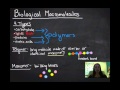
Biological Macromolecules and Reactions

Interactive Video
•
Biology
•
9th - 10th Grade
•
Practice Problem
•
Hard

Patricia Brown
FREE Resource
Read more
10 questions
Show all answers
1.
MULTIPLE CHOICE QUESTION
30 sec • 1 pt
Which of the following is NOT a type of biological macromolecule?
Proteins
Lipids
Vitamins
Carbohydrates
2.
MULTIPLE CHOICE QUESTION
30 sec • 1 pt
What is a polymer?
A long molecule made of similar or identical subunits
A single molecule
A type of nucleic acid
A type of lipid
3.
MULTIPLE CHOICE QUESTION
30 sec • 1 pt
In the analogy used, what do the beads represent?
Polymers
Monomers
Nucleic acids
Lipids
4.
MULTIPLE CHOICE QUESTION
30 sec • 1 pt
What is the main purpose of dehydration synthesis?
To dissolve proteins
To break down polymers
To build polymers by removing water
To create lipids
5.
MULTIPLE CHOICE QUESTION
30 sec • 1 pt
During dehydration synthesis, what is removed from the monomers?
Water
Carbon
Oxygen
Hydrogen
6.
MULTIPLE CHOICE QUESTION
30 sec • 1 pt
What is the opposite process of dehydration synthesis?
Hydrolysis
Condensation
Polymerization
Oxidation
7.
MULTIPLE CHOICE QUESTION
30 sec • 1 pt
What happens to a polymer during hydrolysis?
It becomes a lipid
It gains energy
It breaks down into monomers
It forms a new bond
Access all questions and much more by creating a free account
Create resources
Host any resource
Get auto-graded reports

Continue with Google

Continue with Email

Continue with Classlink

Continue with Clever
or continue with

Microsoft
%20(1).png)
Apple

Others
Already have an account?

