
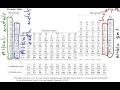
Valence Electrons and Periodic Trends

Interactive Video
•
Chemistry
•
9th - 10th Grade
•
Practice Problem
•
Hard

Patricia Brown
FREE Resource
Read more
10 questions
Show all answers
1.
MULTIPLE CHOICE QUESTION
30 sec • 1 pt
What is the primary focus when considering the shorthand electronic configuration of an element?
Core electrons
Neutrons
Protons
Valence electrons
2.
MULTIPLE CHOICE QUESTION
30 sec • 1 pt
How can you determine the number of valence electrons for silicon using the periodic table?
Count the number of neutrons
Count over to silicon in its row
Count the number of rows above silicon
Count the number of protons
3.
MULTIPLE CHOICE QUESTION
30 sec • 1 pt
What was the initial basis for grouping elements in the periodic table?
Their reactivity
Their density
Their atomic mass
Their color
4.
MULTIPLE CHOICE QUESTION
30 sec • 1 pt
Which of the following is NOT one of the four main groups of elements mentioned?
Noble gases
Halogens
Transition metals
Alkali metals
5.
MULTIPLE CHOICE QUESTION
30 sec • 1 pt
Why do elements tend to achieve a configuration similar to noble gases?
To achieve electronic stability
To change their color
To become more reactive
To increase their atomic mass
6.
MULTIPLE CHOICE QUESTION
30 sec • 1 pt
What charge do alkali metals typically acquire?
+1
0
+2
-1
7.
MULTIPLE CHOICE QUESTION
30 sec • 1 pt
Which group of elements is known for not reacting with others due to their full electron shells?
Alkali metals
Halogens
Noble gases
Alkaline earth metals
Access all questions and much more by creating a free account
Create resources
Host any resource
Get auto-graded reports

Continue with Google

Continue with Email

Continue with Classlink

Continue with Clever
or continue with

Microsoft
%20(1).png)
Apple

Others
Already have an account?

