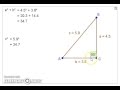
Understanding the Pythagorean Theorem

Interactive Video
•
Mathematics
•
9th - 10th Grade
•
Practice Problem
•
Hard

Patricia Brown
FREE Resource
Read more
10 questions
Show all answers
1.
MULTIPLE CHOICE QUESTION
30 sec • 1 pt
What are the three main questions addressed by the Pythagorean Theorem Explorer?
Types of triangles that satisfy a² + b² = c², those that don't, and the meaning of a, b, and c.
How to calculate the area of a triangle, the perimeter, and the angles.
The history of the Pythagorean theorem, its applications, and its limitations.
The relationship between different types of triangles and their angles.
2.
MULTIPLE CHOICE QUESTION
30 sec • 1 pt
What condition must a triangle meet to satisfy the Pythagorean theorem?
It must have all angles less than 90 degrees.
It must have a 90-degree angle.
It must be an equilateral triangle.
It must have all sides equal.
3.
MULTIPLE CHOICE QUESTION
30 sec • 1 pt
In a right-angle triangle, if a² + b² equals c², what can be concluded?
The triangle is scalene.
The triangle is isosceles.
The triangle is equilateral.
The triangle satisfies the Pythagorean theorem.
4.
MULTIPLE CHOICE QUESTION
30 sec • 1 pt
What happens to the Pythagorean theorem when the angle is greater than 90 degrees?
The triangle becomes equilateral.
a² + b² is less than c².
a² + b² is greater than c².
a² + b² equals c².
5.
MULTIPLE CHOICE QUESTION
30 sec • 1 pt
If the angle at C is less than 90 degrees, what is the relationship between a² + b² and c²?
a² + b² equals c².
a² + b² is greater than c².
a² + b² is less than c².
The triangle becomes isosceles.
6.
MULTIPLE CHOICE QUESTION
30 sec • 1 pt
How can a triangle be adjusted to satisfy the Pythagorean theorem if it doesn't?
Increase the length of side c.
Adjust the angle to exactly 90 degrees.
Decrease the length of side a.
Make all sides equal.
7.
MULTIPLE CHOICE QUESTION
30 sec • 1 pt
What does side 'a' represent in the Pythagorean theorem?
The longest side of the triangle.
The hypotenuse of the triangle.
The side opposite to vertex A.
The side adjacent to angle A.
Access all questions and much more by creating a free account
Create resources
Host any resource
Get auto-graded reports

Continue with Google

Continue with Email

Continue with Classlink

Continue with Clever
or continue with

Microsoft
%20(1).png)
Apple

Others
Already have an account?
Popular Resources on Wayground

15 questions
Fractions on a Number Line

Quiz
•
3rd Grade
20 questions
Equivalent Fractions
Quiz
•
3rd Grade
25 questions
Multiplication Facts
Quiz
•
5th Grade
54 questions
Analyzing Line Graphs & Tables
Quiz
•
4th Grade
22 questions
fractions
Quiz
•
3rd Grade
20 questions
Main Idea and Details
Quiz
•
5th Grade
20 questions
Context Clues
Quiz
•
6th Grade
15 questions
Equivalent Fractions
Quiz
•
4th Grade
Discover more resources for Mathematics
20 questions
Graphing Inequalities on a Number Line
Quiz
•
6th - 9th Grade
18 questions
SAT Prep: Ratios, Proportions, & Percents
Quiz
•
9th - 10th Grade
12 questions
Exponential Growth and Decay
Quiz
•
9th Grade
12 questions
Parallel Lines Cut by a Transversal
Quiz
•
10th Grade
12 questions
Add and Subtract Polynomials
Quiz
•
9th - 12th Grade
15 questions
Combine Like Terms and Distributive Property
Quiz
•
8th - 9th Grade
20 questions
Function or Not a Function
Quiz
•
8th - 9th Grade
10 questions
Elijah McCoy: Innovations and Impact in Black History
Interactive video
•
6th - 10th Grade