
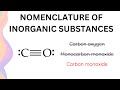
Covalent and Ionic Compounds Concepts

Interactive Video
•
Chemistry
•
9th - 12th Grade
•
Practice Problem
•
Hard

Patricia Brown
FREE Resource
Read more
10 questions
Show all answers
1.
MULTIPLE CHOICE QUESTION
30 sec • 1 pt
Which of the following is considered an inorganic compound?
Carbon Dioxide (CO2)
Glucose (C6H12O6)
Methane (CH4)
Ethanol (C2H5OH)
2.
MULTIPLE CHOICE QUESTION
30 sec • 1 pt
What is the correct name for the diatomic molecule H2?
Hydrogen
Dihydrogen
Hydroxide
Hydride
3.
MULTIPLE CHOICE QUESTION
30 sec • 1 pt
How would you name a compound with the formula N2O4?
Dinitrogen Dioxide
Nitrogen Tetraoxide
Dinitrogen Tetroxide
Nitrogen Oxide
4.
MULTIPLE CHOICE QUESTION
30 sec • 1 pt
What is the prefix used to denote four atoms in a covalent compound?
Quadra
Quatro
Quad
Tetra
5.
MULTIPLE CHOICE QUESTION
30 sec • 1 pt
Which of the following is a characteristic of ionic compounds?
They consist of non-metal atoms sharing electrons.
They have low melting points.
They are composed of metal cations and non-metal anions.
They are always composed of diatomic molecules.
6.
MULTIPLE CHOICE QUESTION
30 sec • 1 pt
What is the correct name for the compound Fe2O3?
Iron(III) Oxide
Iron Oxide
Iron(II) Oxide
Ferric Oxide
7.
MULTIPLE CHOICE QUESTION
30 sec • 1 pt
How do you determine the oxidation state of a transition metal in an ionic compound?
By the number of atoms in the compound
By the charge of the anion
By using Roman numerals in parentheses
By the position of the metal in the periodic table
Access all questions and much more by creating a free account
Create resources
Host any resource
Get auto-graded reports

Continue with Google

Continue with Email

Continue with Microsoft
or continue with

%20(1).png)
Apple

Others
Already have an account?

